







Why do students spend hours progressing through mobile games but often struggle to stay engaged with traditional classroom activities? The answer lies in how learning experiences are designed. Games offer instant feedback, clear goals, rewards, and a sense of achievement that encourages learners to stay motivated and keep improving. By incorporating these elements into education, institutions can create more interactive and engaging learning environments that inspire students to participate actively and take greater ownership of their learning journey.
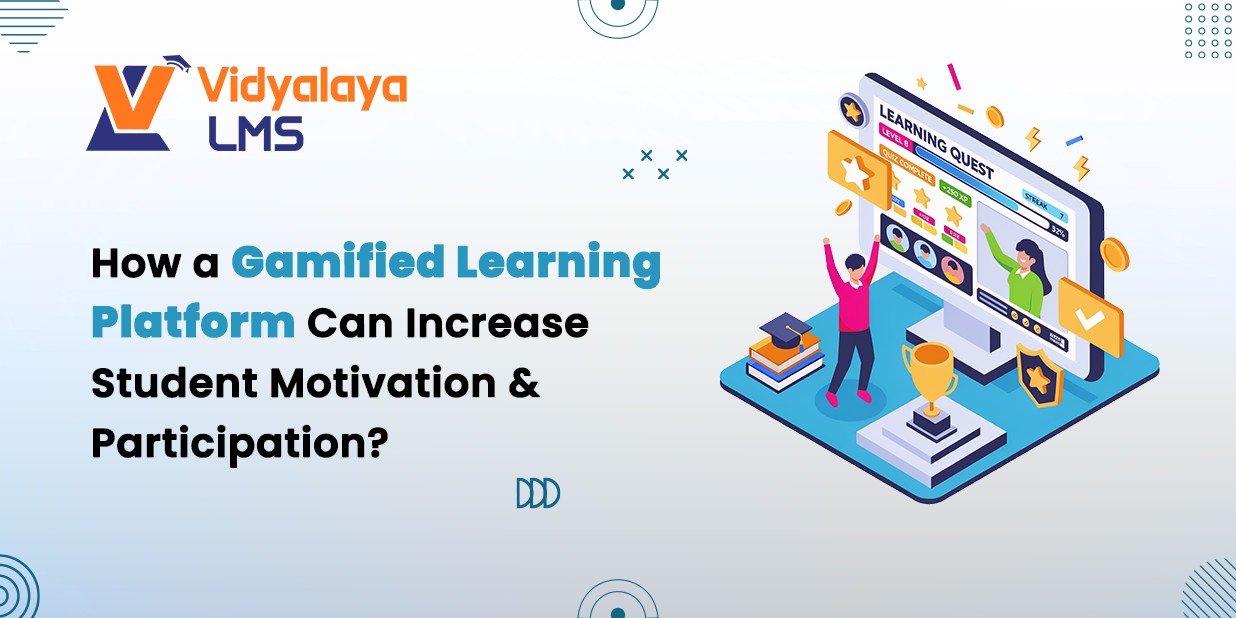
A gamified learning platform integrates game-based elements such as points, badges, leaderboards, challenges, and progress tracking into the learning process to make education more engaging and rewarding. Rather than replacing traditional teaching methods, gamification enhances them by encouraging healthy competition, reinforcing learning outcomes, and motivating students to achieve their academic goals. With a feature-rich Learning Management System (LMS) like Vidyalaya LMS, educational institutions can create dynamic learning experiences that improve student motivation, increase participation, and support better learning outcomes.
Why Traditional Motivation Runs Out of Fuel?
Most classroom motivation runs on delayed, infrequent rewards — a test at the end of the unit, a report card at the end of the term. For a highly motivated student, that’s enough. For everyone else, it’s a four-to-six-week gap between effort and any kind of feedback, and a lot can go wrong in a gap that long. A student who struggles in week two has no signal telling them they’re off track until the grade shows up in week six, by which point disengagement has already set in.
Games never make students wait that long. A point shows up the second an action is completed. A badge unlocks the moment a milestone is hit. That immediacy is exactly what traditional grading structures can’t replicate — and it’s exactly what keeps a student leaning back in, instead of checking out the moment something gets hard.
This isn’t students needing more handholding. It’s a frequency mismatch. Feedback that arrives once a month can’t compete with feedback that arrives every few minutes, and a classroom running on the former is fighting an uphill battle against a brain that’s increasingly used to the latter.
What Actually Drives Participation in a Gamified Learning Platform?
Immediate, visible progress
A student completing a module should see something change right away — points added, a bar filling in, a level cleared. A well-built Gamified Learning Platform turns invisible progress (I understand this topic a bit better now) into something concrete a student can see accumulating.
Competition that doesn’t punish the slower student
Leaderboards work well for students near the top and badly for everyone else, who just see their name sitting at the bottom. Good, gamified learning experiences balance competitive elements — leaderboards, challenges — against individual progress tracking.
Challenges sized to be winnable
The sweet spot — hard enough to require real effort, easy enough to feel achievable — is where sustained engagement lives, and it’s a balance gamified learning software must get right for every student
Rewards tied to effort, not just correct answers
A student who attempts a hard problem and gets it wrong shouldn’t walk away with nothing. Points for attempting, streaks for showing up consistently, badges for improvement — these keep a struggling student in the game instead of quietly opting out the moment the questions get difficult.
Social visibility, in moderation
Seeing a classmate earn a badge creates a mild, healthy pull to keep pace. Seeing a classmate’s score broadcast everywhere, every day, creates the opposite — a reason to stop trying. The platforms that get this right let students opt into how much comparison they want to see
Where Schools Get This Wrong
The most common mistake is bolting a leaderboard onto an existing curriculum and calling it gamified. Slapping points on top of the same worksheets doesn’t change the underlying feedback loop — it just adds a number nobody asked for. Real Gamified Learning rebuilds the feedback cycle itself, not just the scoreboard sitting on top of it.
The second mistake is over-indexing on competition. A classroom where three students dominate every leaderboard every week doesn’t motivate the other twenty-two — it just gives them one more reason to feel like they’re losing. Schools that lean entirely on rankings, without individual progress tracking underneath, usually see engagement climb for a handful of students and quietly drop for everyone else.
The third mistake is assuming gamification is only for younger students. Older students respond just as strongly to clear progress and immediate feedback — they’re just less interested in cartoon mascots and badges shaped like stars. A gamified learning platform built for a ninth grader needs a different visual language than one built for a seven-year-old, even if the underlying mechanics — points, streaks, visible progress — stay the same.
Conclusion:
A well-implemented gamified learning platform can help educational institutions move beyond traditional teaching approaches and create more engaging, interactive, and student-centric learning experiences. By combining instant feedback, personalized progress tracking, meaningful rewards, and balanced competition, schools can encourage active participation, strengthen learning motivation, and support continuous academic improvement. The key is to choose a reliable Learning Management System (LMS) that integrates gamification seamlessly into the learning process while aligning with institutional goals and student needs.
Vidyalaya LMS empowers educational institutions with technology-driven learning solutions designed to make education more engaging, effective, and accessible. If you want to improve student motivation, increase classroom participation, and deliver a more interactive learning experience, Vidyalaya LMS can help you take the next step toward smarter digital education. Contact us today for a free demo and discover how Vidyalaya LMS can transform your institution’s learning experience.