







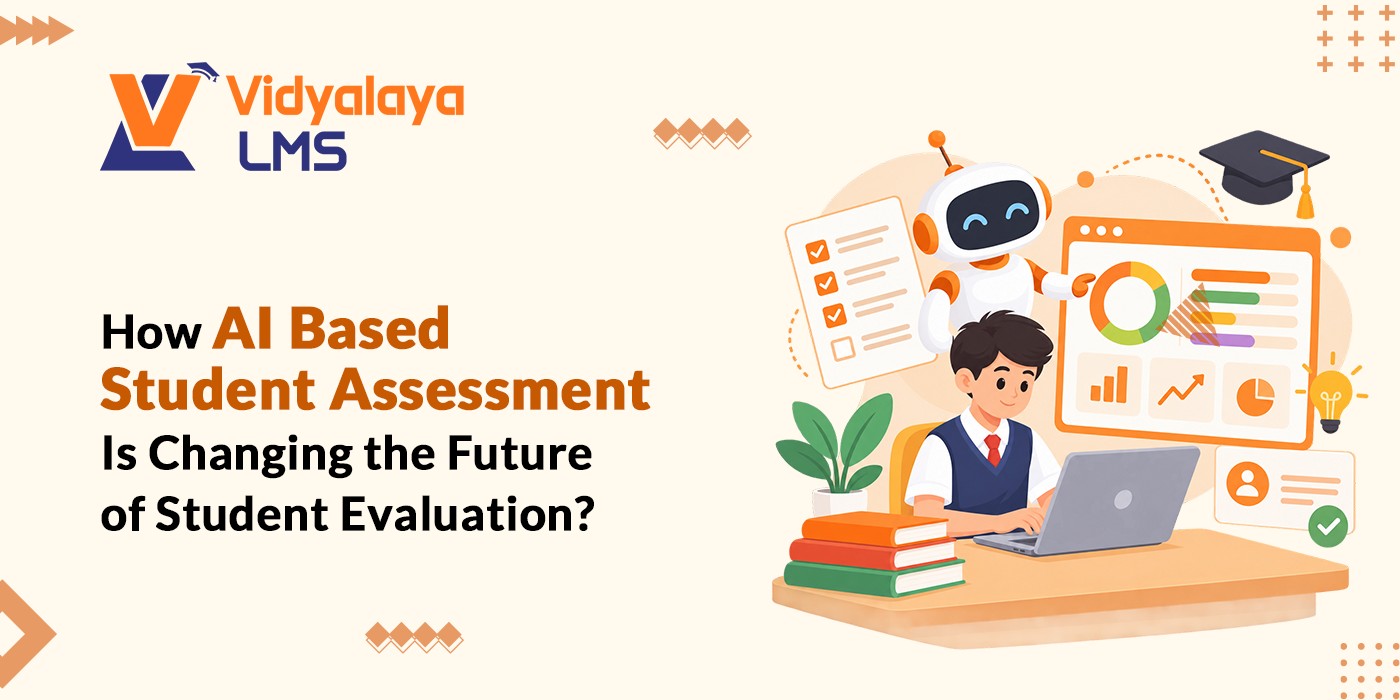
Student assessment plays a vital role in understanding learners’ knowledge, identifying learning gaps, and tracking academic progress. However, traditional assessment methods often depend on manual processes, paperwork, and marks-based evaluation. With the rapid adoption of digital education, AI Based Student Assessment is helping institutions make student evaluation more accurate, efficient, and data driven.
AI-powered assessment solutions can analyze student responses, identify learning patterns, provide personalized feedback, and help educators make informed academic decisions. When integrated with a modern Learning Management System (LMS), assessment becomes a continuous process rather than a one-time activity, enabling institutions to deliver more personalized learning experiences and improve student outcomes.
Moving Beyond Traditional Student Evaluation
Typical testing does not offer a comprehensive assessment. A learner gets a score or grade; however, this does not necessarily explain the reasons for the good or poor performance on this task.
Digital assessment offers a broader picture. Teachers can track performance on quizzes, homework, tests, participation, and progress. Rather than analyzing just one examination result, teachers can track patterns in several learning activities.
This change makes student-based assessment increasingly relevant for contemporary education. Instead of the usual question of how many marks the student received, the focus is shifting to “What did the student learn, what were the difficulties, and what should be done further?
How AI Can Help in Assessing Student Performance?
AI can make the process of assessment more intelligent. Rather than having teachers analyze all available data by themselves, AI can assist in processing learner data on a larger scale.
For instance, AI can detect learners struggling with a specific topic on an ongoing basis.
This does not mean replacing teachers. Rather, AI gives educators better information so they can spend more time supporting students and less time handling repetitive assessment-related tasks.
Some important ways AI can support evaluation include:
- Analyzing student responses and performance patterns
- Identifying possible learning gaps
- Supporting personalized feedback
- Tracking performance over multiple assessments
- Helping educators identify students who may need additional support
- Generating useful performance insights from assessment data
The Rise of Student Online Assessment
In addition, the advent of digital learning has also impacted the process of examination for students. A student online assessment refers to the practice where students take quizzes, tests, assignments, and other forms of evaluations through a digital medium.
The process of evaluation becomes more convenient due to such methods. This means that teachers can conduct their assessments, assign them to the learners, and evaluate them easily from a central location.
There can also be various forms of questions that can be used through an online digital form. Multiple choice questions, description-type questions, quizzes, assignments, and other forms of assessment can also be included according to the need of the teaching
Continuous Tracking with a Student Assessment Tracker
The assessment process should not just be done through the final exam. The continuous monitoring helps the teachers have a better understanding of how the student is performing in the class.
Using a student assessment tracker, the information on the students’ assessments is brought together to enable the teacher to easily monitor their performance. This will help teachers avoid checking different spreadsheets and notebooks.
This can help answer important questions:
- Is the student improving over time?
- Which topics are creating difficulties?
- How consistently is the learner completing assessments?
- Which students may need additional academic support?
- Are learning outcomes being achieved?
This way, educators do not need to wait until the end of the term to find out that the student is having problems.
Personalized Learning with Enhanced Evaluation
Every student is unique. Each one has his or her own strengths, weaknesses, and rates of learning. There is no universal evaluation technique that would cover all cases.
AI-based student evaluation system can be used by institutions to introduce more personalized learning approach. When the performance of the student is evaluated on a constant basis, educators can find out more about individual learning requirements.
If a student is doing great in one area and fails to learn another topic consistently, the LMS system will allow the teacher to detect this discrepancy. The additional learning materials, exercises, and revision can be suggested.
This way, the link between the evaluation and the learning process becomes tighter.
How Assessment Software Helps Teachers?
When an educational institution has several hundred or even thousands of students, it becomes complicated to manage the assessments by hand. It takes a lot of time to create tests, enter the marks, check them, create reports, etc. Modern student assessment software helps centralize these activities. Educators can manage assessments digitally, organize learner results, and review performance without depending on multiple disconnected tools.
This creates a better structure for assessments whereby information is easily accessible and can be applied efficiently.
The Use of AI in Giving Feedback and Improving Learning
Feedback is among the key aspects of assessment processes. Whereas a score tells a learner about their performance, feedback indicates what needs to be done to enhance it.
An AI application could assist teachers in assessing students’ performance and indicating where some clarifications or practice are required. In combination with experience, such information will help create more relevant feedback for every learner.
For a learner, timely feedback makes the process of study more motivating because he or she does not have to wait till the end of the course for feedback on improvements. The Future of Learner Evaluation Process Instead of depending mainly on periodic examinations, institutions can use multiple learning activities to build a more complete picture of student progress.
AI can help process this information, but educators will continue to play the most important role. Technology can identify patterns and provide insights, while teachers bring context, experience, and human understanding to the decision-making process.
As digital learning continues to grow, assessment will increasingly become part of everyday learning rather than a separate event at the end of a course
Conclusion
AI-based student assessment is transforming how educational institutions understand, monitor, and improve student performance. By combining AI-powered insights with a modern LMS, institutions can streamline assessment processes, reduce administrative effort, identify learning gaps earlier, and support more personalized learning. A well-structured student-based assessment approach can help educators make data-driven decisions while keeping students at the center of the learning journey.
With the right technology, assessment can become a continuous part of teaching and learning rather than a periodic activity. Vidyalaya LMS helps institutions simplify digital assessments, track student progress, and gain meaningful insights through a centralized learning platform. Contact us today for a free demo and discover how Vidyalaya LMS can support smarter, more effective student assessment.