





How a Gamified Learning Platform Can Increase Student Motivation & Participation?

Vidyalya LMS

Why do students spend hours progressing through mobile games but often struggle to stay engaged with traditional classroom activities? The answer lies in how learning experiences are designed. Games offer instant feedback, clear goals, rewards, and a sense of achievement that encourages learners to stay motivated and keep improving. By incorporating these elements into education, institutions can create more interactive and engaging learning environments that inspire students to participate actively and take greater ownership of their learning journey.

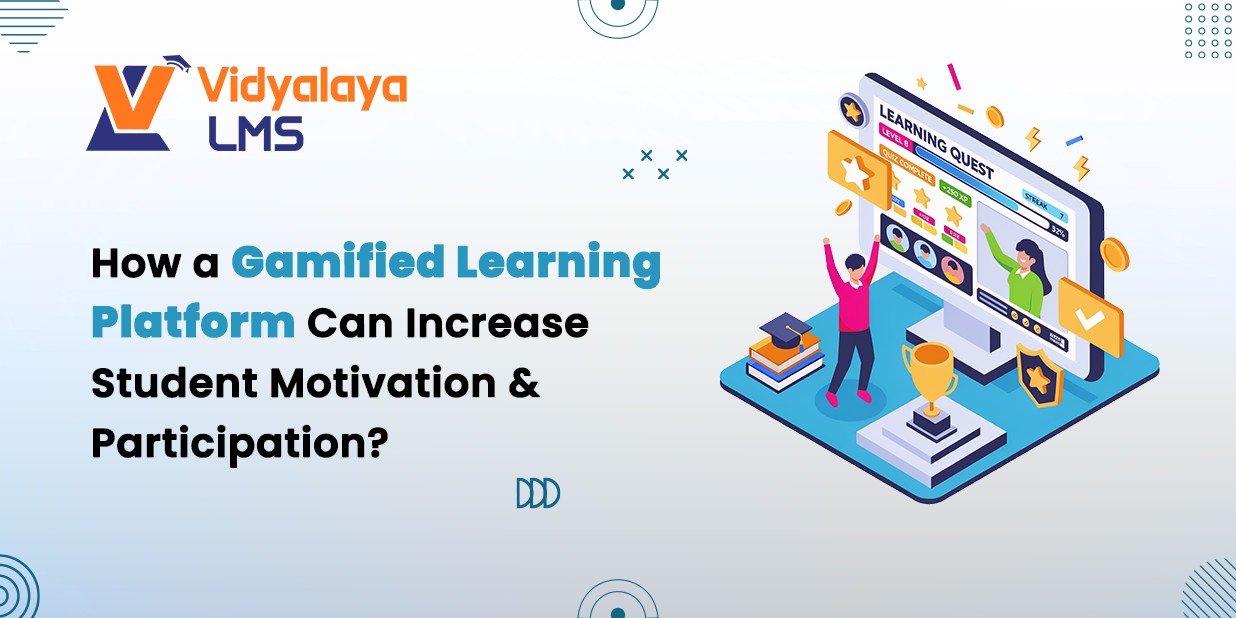
A gamified learning platform integrates game-based elements such as points, badges, leaderboards, challenges, and progress tracking into the learning process to make education more engaging and rewarding. Rather than replacing traditional teaching methods, gamification enhances them by encouraging healthy competition, reinforcing learning outcomes, and motivating students to achieve their academic goals. With a feature-rich Learning Management System (LMS) like Vidyalaya LMS, educational institutions can create dynamic learning experiences that improve student motivation, increase participation, and support better learning outcomes.

Why Traditional Motivation Runs Out of Fuel?

Most classroom motivation runs on delayed, infrequent rewards — a test at the end of the unit, a report card at the end of the term. For a highly motivated student, that’s enough. For everyone else, it’s a four-to-six-week gap between effort and any kind of feedback, and a lot can go wrong in a gap that long. A student who struggles in week two has no signal telling them they’re off track until the grade shows up in week six, by which point disengagement has already set in.

Games never make students wait that long. A point shows up the second an action is completed. A badge unlocks the moment a milestone is hit. That immediacy is exactly what traditional grading structures can’t replicate — and it’s exactly what keeps a student leaning back in, instead of checking out the moment something gets hard.

This isn’t students needing more handholding. It’s a frequency mismatch. Feedback that arrives once a month can’t compete with feedback that arrives every few minutes, and a classroom running on the former is fighting an uphill battle against a brain that’s increasingly used to the latter.

What Actually Drives Participation in a Gamified Learning Platform?

Immediate, visible progress
A student completing a module should see something change right away — points added, a bar filling in, a level cleared. A well-built Gamified Learning Platform turns invisible progress (I understand this topic a bit better now) into something concrete a student can see accumulating.

Competition that doesn’t punish the slower student
Leaderboards work well for students near the top and badly for everyone else, who just see their name sitting at the bottom. Good, gamified learning experiences balance competitive elements — leaderboards, challenges — against individual progress tracking.

Challenges sized to be winnable
The sweet spot — hard enough to require real effort, easy enough to feel achievable — is where sustained engagement lives, and it’s a balance gamified learning software must get right for every student

Rewards tied to effort, not just correct answers
A student who attempts a hard problem and gets it wrong shouldn’t walk away with nothing. Points for attempting, streaks for showing up consistently, badges for improvement — these keep a struggling student in the game instead of quietly opting out the moment the questions get difficult.

Social visibility, in moderation
Seeing a classmate earn a badge creates a mild, healthy pull to keep pace. Seeing a classmate’s score broadcast everywhere, every day, creates the opposite — a reason to stop trying. The platforms that get this right let students opt into how much comparison they want to see

Where Schools Get This Wrong

The most common mistake is bolting a leaderboard onto an existing curriculum and calling it gamified. Slapping points on top of the same worksheets doesn’t change the underlying feedback loop — it just adds a number nobody asked for. Real Gamified Learning rebuilds the feedback cycle itself, not just the scoreboard sitting on top of it.

The second mistake is over-indexing on competition. A classroom where three students dominate every leaderboard every week doesn’t motivate the other twenty-two — it just gives them one more reason to feel like they’re losing. Schools that lean entirely on rankings, without individual progress tracking underneath, usually see engagement climb for a handful of students and quietly drop for everyone else.

The third mistake is assuming gamification is only for younger students. Older students respond just as strongly to clear progress and immediate feedback — they’re just less interested in cartoon mascots and badges shaped like stars. A gamified learning platform built for a ninth grader needs a different visual language than one built for a seven-year-old, even if the underlying mechanics — points, streaks, visible progress — stay the same.

Conclusion:

A well-implemented gamified learning platform can help educational institutions move beyond traditional teaching approaches and create more engaging, interactive, and student-centric learning experiences. By combining instant feedback, personalized progress tracking, meaningful rewards, and balanced competition, schools can encourage active participation, strengthen learning motivation, and support continuous academic improvement. The key is to choose a reliable Learning Management System (LMS) that integrates gamification seamlessly into the learning process while aligning with institutional goals and student needs.

Vidyalaya LMS empowers educational institutions with technology-driven learning solutions designed to make education more engaging, effective, and accessible. If you want to improve student motivation, increase classroom participation, and deliver a more interactive learning experience, Vidyalaya LMS can help you take the next step toward smarter digital education. Contact us today for a free demo and discover how Vidyalaya LMS can transform your institution’s learning experience.

Frequently Asked Questions

1. What is a gamified learning platform, and how does it benefit students?

A gamified learning platform incorporates elements such as points, badges, challenges, and rewards into educational activities. It helps improve student engagement, encourages active participation, and makes learning more interactive and goal oriented.

2. How does gamification improve student motivation and classroom participation?

Gamification motivates students through instant feedback, achievable goals, progress tracking, and healthy competition. These features encourage learners to participate consistently, complete assignments, and take a more active role in their education.

3. What features should schools look for in educational gamification software?

Schools should look for features such as achievement badges, leaderboards, progress tracking, interactive quizzes, rewards, and performance analytics. These capabilities help educators monitor student engagement and create more personalized learning experiences.

4. Can gamified learning improve academic performance?

Gamified learning can support academic improvement by encouraging regular practice, reinforcing concepts, and providing timely feedback. Its effectiveness depends on how well the activities align with learning objectives, teaching strategies, and individual student needs.

5. Is gamification suitable for higher education and older students?

Yes, gamification can benefit schools, colleges, universities, and professional training programs. Challenges, achievement milestones, interactive assessments, and progress dashboards can be tailored to different age groups and learning requirements.

6. How can educational institutions measure the success of gamified learning?

Institutions can evaluate effectiveness by tracking course completion rates, assessment scores, assignment submissions, participation levels, and learner progress. These insights help educators identify engagement gaps and improve their teaching strategies.

7. How does Vidyalaya LMS help institutions create engaging learning experiences?

Vidyalaya LMS provides a digital learning environment that helps educational institutions streamline learning activities and support student engagement. Institutions can explore its LMS capabilities to identify solutions that align with their teaching, assessment, and learning management requirements.

8. How can schools explore Vidyalaya LMS for their learning needs?

Schools and educational institutions can contact Vidyalaya LMS to discuss their digital learning requirements and explore suitable LMS capabilities. Request a free demo to understand how the platform can support your institution’s goals for a more engaging learning experience.

author

The Author

Kumaril Patel

CEO & Co-Founder

LinkedIn Icon

Kumaril Patel is the CEO & Co-Founder of Sapphire Software Solutions, a global technology company specializing in software, mobile app, and web development. With over 20 years of diverse IT leadership, he has built international business operations from the ground up and led the leading flagship digital platforms such as Vidyalaya School Management System and OccuCare Occupational Health Management System.

Kumaril is known for transforming ideas into high-impact technology solutions—leading cross-functional global teams and building innovation-driven ecosystems. His strategic vision has enabled long-standing collaborations with global enterprises including American Express, Bayer, TATA Group, Adani Group, Larsen & Toubro, Honda, Toyota and Vedanta Limited.

Passionate about innovation, AI, and cloud technologies, Kumaril focuses on empowering organizations to scale globally while solving real-world challenges through transformative digital solutions.

Related Blog

sapphire
September 30, 2026 5 min read
Education is rapidly evolving as schools embrace digital transformation to create more connected, personalized, and outcome-driven learning experiences. Traditional teaching methods centred around textbooks, classroom instruction, and standardized assessments are increasingly being complemented by intelligent digital solutions. An AI-powered Learning Management System (LMS) for schools enables educational institutions to streamline academic processes, improve learner engagement, and support teachers with data-driven insights, creating a smarter and more efficient learning environment. However, simply digitizing educational content is not enough to meet the evolving needs of modern schools. An AI-powered LMS can go beyond online classes and course management by analyzing learner performance, […]
Read More Vidyalaya LMS
sapphire
July 22, 2026 5 min read
Traditional teaching methods often emphasize memorization and passive learning, but today’s education landscape demands a more practical and skill-focused approach. Students are expected to think critically, solve complex challenges, collaborate effectively, and apply knowledge in real-world situations. This shift has increased the demand for innovative teaching strategies and student engagement software that improve student engagement, strengthen critical thinking, and deliver better learning outcomes. Among these modern approaches, Problem Based Learning (PBL) has emerged as a highly effective methodology for preparing learners with the skills required for academic and professional success. Student Centered Learning is an instructional approach where learners actively […]
Read More Vidyalaya LMS
sapphire
October 21, 2024 4 min read
Online education, then, can serve two goals. For students lucky enough to have access to great teachers, blended learning can mean even better outcomes at the same or lower cost. And for the millions here and abroad who lack access to good, in-person education, online learning can open doors that would otherwise remain closed. – Daphne Koller. The importance of e-learning is summarized in the above statements. And market figures are even proving it right. According to the latest news, the e-learning market is expected to exhibit a growth rate of 8.3% CAGR during 2024-2032. The moral of all the above is that embracing e-learning […]
Read More Vidyalaya LMS
Success Icon