







Providing learning to various types of individuals including learners and employees can be difficult. To overcome problems like these, it is required for education institutions as well as companies to have a new approach for providing learning resources and tracking progress. Conventional learning involves the use of various pieces of software and performing some manual operations.
With the increasing operations in schools, colleges and enterprises there is an increase in the demand for an effective learning tool which makes it easier for every type of learner. This may take a long time at an individual level and may be difficult to maintain consistency in training. Enterprise digital learning platforms can be very useful. They help organisations manage their learning by providing tools such as course management, learner management and performance management.
This blog discusses how enterprise learning platforms work, why they are important and what features they have. We will also investigate how Vidyalaya LMS provides consistent digital learning.
What Are Enterprise eLearning Solutions?
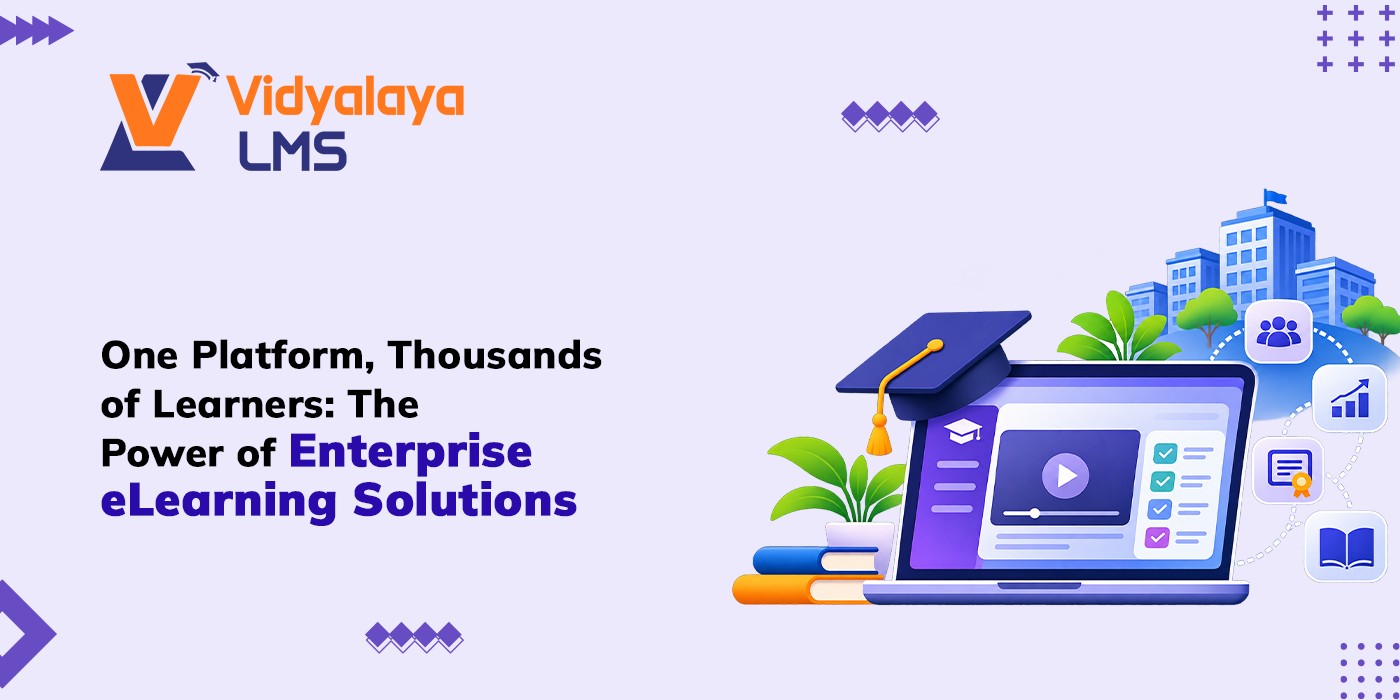
Enterprise Learning Solution is a digital learning solution intended to control the training and learning processes within an entire organization. It offers a platform where administrators, teachers, trainers, and learners have access to all the necessary learning materials.
As opposed to ordinary online learning solutions, enterprise solutions are created to cater to more learners, courses, and different users. For instance, a school organization comprising several branches may require that the same learning materials be offered to teachers from different branches. In addition, an organization may require that its employees undergo training. A learning management platform allows controlling these processes without using various systems for different organizations
Why Do Large Institutions Need Enterprise eLearning?
The more learners there are, the more complex it can become to manage the learning activities. Having a clear system makes it easier to deliver the content.
Below are some common problems:
1. Managing Many Learners
With several hundred or thousands of learners to administer through spreadsheets and other means of administration becomes increasingly difficult. The institution needs to have an efficient system which would allow the administration to register learners, assign them courses and provide them with access to learning.
2. Guarantee Consistency
If the trainers will train the learners in different places, the chances are they may give them different information. The use of the common digital platform will allow the institutions to make sure all the learners get the same learning material.
3. Save Time on Administration
Administration of learner assignments, training, assessment and learning progress can become very tedious. Through automation of this process the Administrators and trainers will be able to save time and effort in managing the learning process and focus on its improvement instead.
4. Monitoring Learning Process
Institutions will want to monitor the learners’ progress and the successful completion of their courses. The digital learning platform provides information on the course completion, assessment result, participation and progress of individuals.
Important Characteristics of an Enterprise Learning Management System
An Enterprise eLearning Software should be more than just the ability to store academic materials online. The system must be capable of covering the entire process of learning, from creating courses to assessing performance.
Some of the most important characteristics are:
Centralized Course Management
Course managers and administrators must be able to create, manage, update and distribute the created courses from one point. In this way, it will become much simpler to control multiple learning programs and organize all the content.
Flexible Access to Learning Materials
Learners may have different learning time and preferences. Therefore, they must have the option to access all necessary learning resources according to their schedule, including through supported mobile devices.
Online Assessments and Evaluations
Quiz, test, and assignments help to assess whether the learner has learned something. Also, assessments can indicate which topics require additional explanations.
User Roles and Access Permissions
There are different roles on the platform, where the administrator is responsible for management, teachers create and deliver learning activities while students or employees use the assigned courses.
Reporting and Analytics
Reports help institutions review learner activity, course completion, and assessment performance. These insights support better planning and help educators make informed decisions.
Communication and Collaboration
Discussion activities, announcements, and other communication features can help learners interact with educators and stay informed about their learning activities
The Role of eLearning Software for Schools
Schools require specific Learning Management Systems. They need a system which facilitates the delivery of learning in the classroom, digital learning resources, assessment, along with teacher and student activities.
The eLearning Software for Schools allows teachers to provide additional learning resources. Students can access previous learning programmes, digital resources and learning activities based around the learning programmes created by the school.
From a teacher’s perspective, digital resources can make it easier to deliver resources and assessment.
Conclusion:
The real value of enterprise eLearning isn’t simply putting thousands of learners online; it’s making sure that every learner gets the right resources, guidance, and learning opportunities without creating additional administrative complexity. As institutions expand, their learning approach must grow with them. A well-implemented LMS brings structure to this growth by connecting educators, administrators, trainers, and learners through a shared digital environment. This allows organizations to move beyond scattered learning activities and build a more coordinated, measurable learning experience.
With Vidyalaya LMS, institutions can take a more organized approach to managing large-scale learning, from distributing educational content to monitoring learner progress. Instead of letting growing learner numbers create management challenges, turn that growth into an opportunity to improve how learning is delivered. Contact us today for a free demo and explore how a centralized LMS can support your institution’s evolving learning needs.