






If you visit schools or colleges today, you will see the same thing happening behind the scenes. The people who handle admissions are juggling lots of spreadsheets. The accounts department has its own software. Teachers are uploading grades to one website while students are checking another website for their results. Somewhere in the middle, an administrator is trying to make sense of all the data that does not match.
This sounds like a problem with the systems they use. But it is not an issue. It is a problem of trust. When parents cannot get updates in time, students must visit different websites for basic information, and when principals cannot see the full picture without manually pulling reports, the institution loses credibility. This happens slowly and quietly. It is sure to happen. That is the reality that is driving schools and colleges towards Education ERP. Especially solutions that have LMS integration built in. They are not doing this because it is a trend. Because the old way is not working anymore.
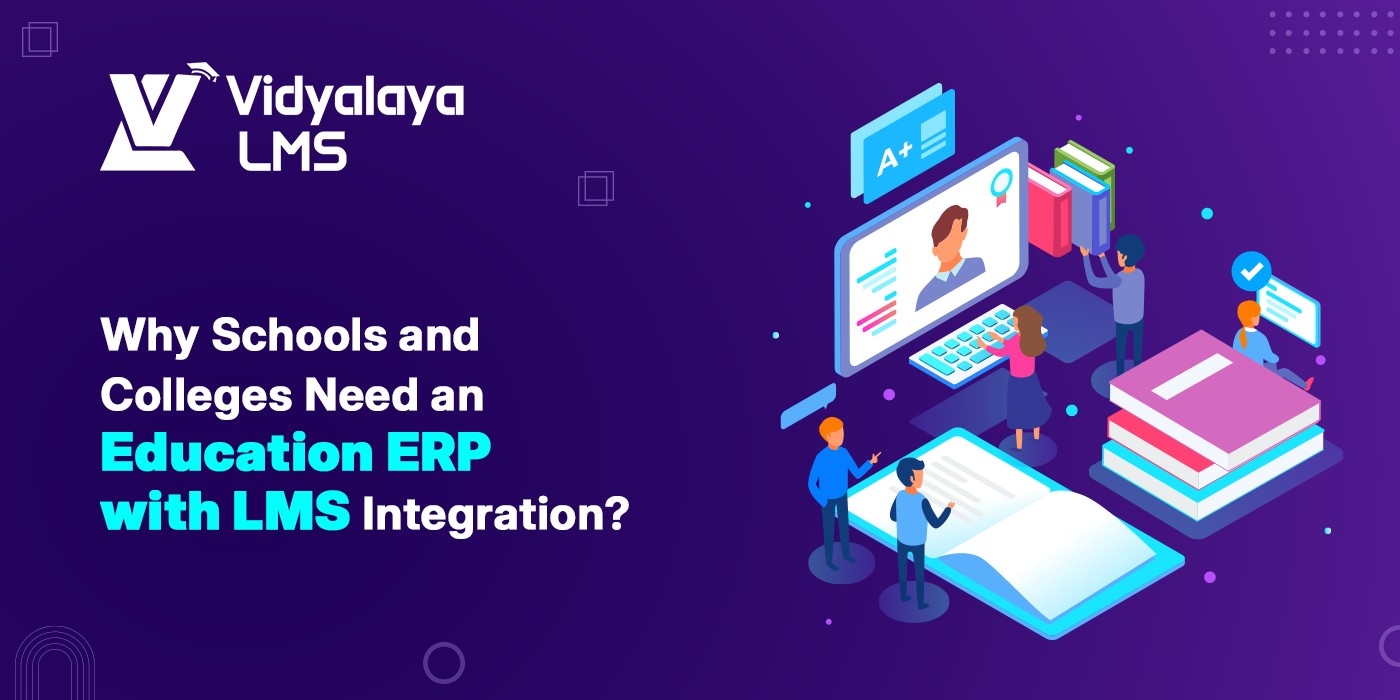
What Is an Education ERP with LMS Integration?
Think of an Education ERP Solution as the central system of your institution. It handles all the tasks. Admissions, fees, HR, payroll, timetabling, library, and compliance. All from one place. Now, if you add an LMS on top of that, you connect the system with the actual learning that happens in classrooms.
When Enterprise Learning Management Software is properly embedded into an ERP, it does something. It takes a student’s attendance, their coursework submissions, and their assessment scores. And ties all of that into the institutional record. There is no need for syncing. There is no need to say, “Let me check two systems and get back to you.”
For colleges and universities, ERP Higher Education platforms go further. They are built to handle the complexity that comes with departments, diverse programs, research wings, and alumni networks. Things that a school-level tool is not designed for.
Why Is This Gaining Much Ground Now?
To be fair, ERP systems in education are not new. What has changed is the urgency. A year ago, institutions could get away with running disconnected tools. Students tolerated it. Parents accepted it…The expectations have changed significantly, and there are a few reasons why Education ERP adoption is reaching a tipping point in 2026.
One reason is that the students coming in today grew up with digital experiences. They use apps that know their preferences, sync across devices, and update in time. Logging into four websites to find their timetable, fee dues, grades, and course material feels frustrating to them. And it should. There is also pressure. Educational boards and accreditation bodies are asking for structured, auditable data. Maintaining that manually or across platforms is becoming difficult to justify.
Then there is the reality of blended learning. Hybrid models are not going away. Enterprise Learning Management Software that integrates with the institution’s core operations is not a “nice to have” anymore. It is what makes hybrid learning work at scale. Institutions across India and globally are waking up to this. Manual workflows and patchwork software setups are not just inefficient. They are quietly costing institutions students, staff, and reputation.
Why Does ERP with LMS Integration Actually Matter?
1. Everything About a Student in One Place:
From the day a student submits an application to the day they graduate, every milestone is. Enrollment, academics, fees, and placements. There is no need to chase records across departments. There is no silence when a parent asks a simple question.
2. Admin and Academics Finally Talk to Each Other:
When an LMS and ERP work as one system, a teacher marking attendance in class does not need to update the student portal. A grade submitted flows directly into the record. These might seem like things, but they save a lot of time. And eliminate a surprising number of errors.
3. Decisions Based on Real Data, Not Gut Feeling:
One of the underappreciated benefits of a well-implemented ERP Higher Education platform is what it does for leadership. Principals, deans, and administrators get reports that combine fee collection data, staff attendance, course completion rates, and student performance trends. All in one view. That is the kind of clarity that leads to decisions.
4. Students and Parents Actually Feel the Difference:
When a student can check their results, download a fee receipt, view their timetable, and access course materials from a login, the experience feels professional. Parents who receive accurate updates do not need to keep calling the school office. That kind of transparency builds a lot of goodwill.
5. It Grows with You:
A school with 800 students today might have 4,000 students in five years. A university adding departments should not have to rebuild its systems from scratch.
6. The Cost Argument Is Simple:
Running five software subscriptions, training staff on each, and paying an IT team to maintain integrations between them adds up fast. Consolidating into one Education ERP Solution cuts licensing costs, reduces the training burden, and frees up budget for things that improve learning outcomes.
What Does the Road Ahead Look Like?
AI-driven personalization, predictive analytics for student retention, and adaptive learning paths are no longer science fiction. They are features showing up in Enterprise Learning Management Software right now. None of that potential is accessible to institutions still running on disconnected, legacy systems.
The institutions that will stand out in 2026 and the years following are the ones that have built a technological foundation today. Choosing the ERP for Higher Education. One that genuinely integrates learning management at its core. Is not just an IT decision. It shapes student outcomes, institutional reputation, and long-term growth.
The good news is that getting started does not require an overnight overhaul. Most implementations happen in phases with measurable improvements visible well before the full rollout is complete.
Conclusion:
In 2026, schools and colleges can no longer rely on disconnected systems that create delays, errors, and communication gaps between administration, faculty, students, and parents. An Education ERP with LMS integration brings everything onto a single platform—streamlining operations, improving transparency, and enabling data-driven decision-making. Institutions that adopt this unified approach are better equipped to deliver a seamless learning experience while building trust and efficiency across all stakeholders.
At Vidyalaya LMS, we help educational institutions move beyond fragmented tools by offering a complete ERP with an integrated LMS designed for modern academic needs. From admissions and academics to communication and reporting, everything works together in one system. Contact us for a free demo today and discover how Vidyalaya LMS can transform your institution into a smarter, more connected campus.