








Organizations today are under constant pressure to improve performance, reduce skill gaps, and keep their workforce aligned with changing business priorities. As roles evolve and technologies advance, relying on outdated training methods can slow productivity and limit growth. A strategically designed Training Program for Employees enables organizations to standardize knowledge, accelerate skill development, and ensure consistent performance across teams—directly impacting operational efficiency and business outcomes.
Modern Employee Training Programs powered by digital learning platforms allow companies to move beyond one-time training sessions and build a continuous learning ecosystem. By leveraging Corporate Training Software and Learning Management Systems, organizations can deliver role-based training, track progress, and measure learning impact in real time. This structured, technology-driven approach not only strengthens employee capabilities but also supports scalability, compliance, and long-term organizational success.
What Is an Employee Training Program?
An employee training program is a planned approach to improving employee skills, knowledge, and competencies. It covers everything from onboarding new hires to upskilling existing employees and developing leadership capabilities.
Training programs may include:
- Orientation and onboarding sessions
- Technical and job-specific training
- Soft skills and communication development
- Compliance and policy training
- Leadership and management development
When delivered through digital platforms, training becomes more flexible, measurable, and effective.
Importance of Employee Training for the Success of Businesses:-
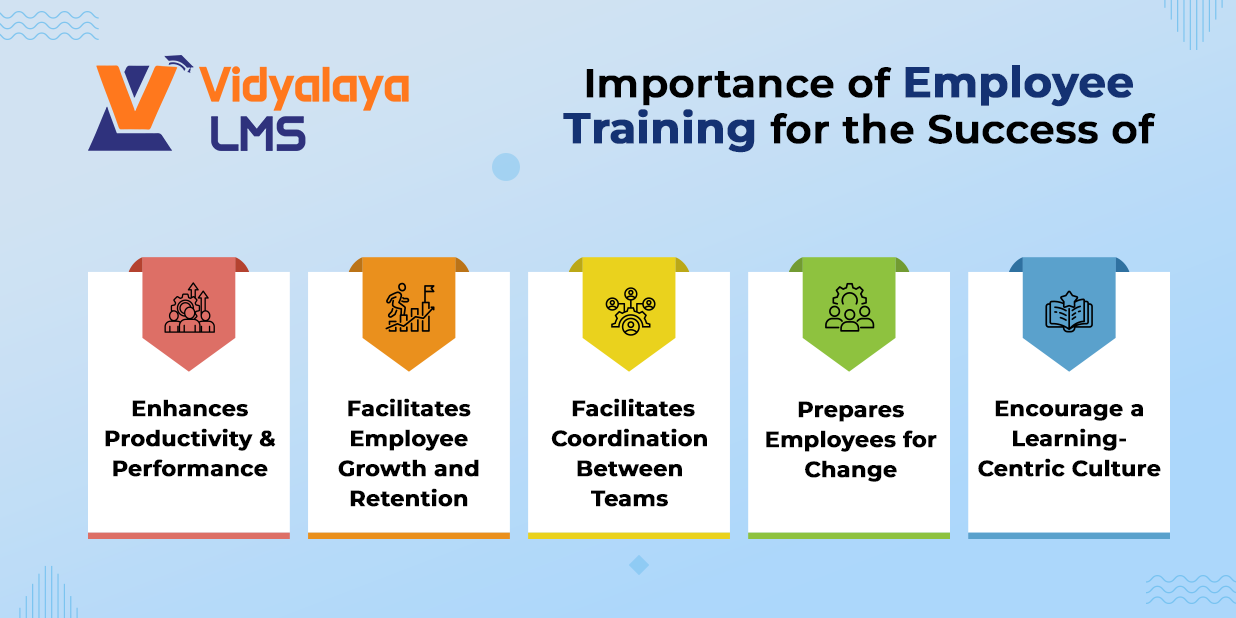
- Enhances Productivity & Performance: Employees who have been well-trained are more efficient in their tasks. They tend to make fewer mistakes. The quality of work.
- Facilitates Employee Growth and Retention: The organizations that focus on learning experience higher worker satisfaction rates along with lower rates of worker turnover.
- Facilitates Coordination Between Teams: This ensures that the processes, values, and expectations are well communicated.
- Prepares Employees for Change: It facilitates the formation of preparation teams for adjusting to new technology and business models.
- Encourage a Learning-Centric Culture: Continuous learning fosters innovation, teamwork, and accountability.
Role of Corporate Training Programs in Modern Organizations:-
A corporate training program aligns employee development with business goals. Instead of ad-hoc learning, it offers structured pathways that help employees grow alongside the organization.
Key benefits include:
- Faster onboarding of new employees
- Improved leadership pipelines
- Better cross-functional collaboration
- Reduced dependency on external hiring
- Stronger organizational culture
When training is aligned with performance metrics, businesses can clearly see the impact of learning initiatives.
Workplace Training Solutions in the Digital Era:-
Traditional classroom-based training often struggles with scalability, consistency, and time constraints. Modern workplace training solutions overcome these challenges through digital delivery.
Digital training enables organizations to:
- Train employees across locations
- Offer self-paced and flexible learning
- Track progress and completion in real time
- Update content quickly and easily
- Measure learning outcomes with analytics
This approach ensures training reaches every employee without disrupting daily operations.
Importance of Employee Learning and Development:-
Whereas employee learning and development are long-term oriented and focus more on an employee’s growth rather than their short-term skill gaps, it helps employees take responsibility for their own career development and contribute to the organization more productively.
Include, but are not limited to:
- Value addition to problem-solving and decision-making
- Stronger leadership capabilities
- Increased engagement and motivation
- Better adaptability to industry changes
Organizations that invest in learning create a workforce that is confident, capable, and future-ready.
Corporate Training Software and Employee Onboarding Software:-
Digital platforms play a crucial role in modern training strategies.
Corporate Training Software helps by:
- Centralizing training content
- Managing courses and certifications
- Tracking employee learning progress
- Providing reports and insights
- Supporting blended and online learning models
Employee Onboarding Software ensures:
- Faster integration of new hires
- Clear understanding of roles and expectations
- Consistent onboarding experiences
- Reduced training time and errors
Together, these tools create a seamless learning journey from day one.
Challenges Businesses Face Without Structured Training:-
Organizations without proper training systems often face:
- Skill gaps and inconsistent performance
- High employee turnover
- Poor onboarding experiences
- Low engagement and morale
- Difficulty scaling operations
Structured training programs supported by digital platforms help overcome these challenges efficiently.
Conclusion:
Investing in a structured employee training program is no longer just a talent development initiative—it is a strategic lever for business growth. Organizations that prioritize skill enhancement, continuous learning, and technology-driven training not only improve workforce productivity but also strengthen their competitive advantage. By adopting a modern Learning Management System, such as Vidyalaya LMS, companies can ensure their teams stay agile, skilled, and aligned with evolving business goals.
Ready to transform your workforce and drive measurable results? Contact us today for a free demo and discover how Vidyalaya LMS can help your organization create a culture of continuous learning while maximizing performance and growth.