







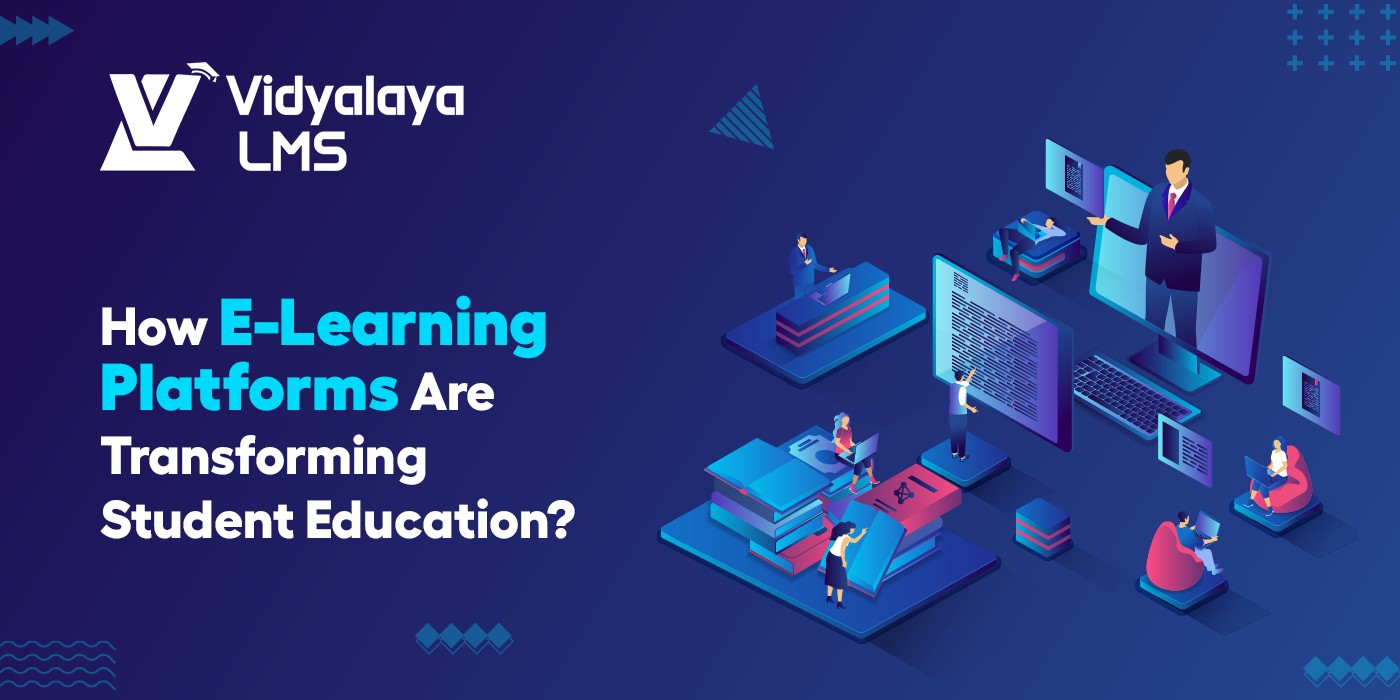
Spend five minutes talking to a school teacher from 2015 about how their students learn today, and the conversation gets interesting fast. Back then, a “digital classroom” meant a projector on the wall and maybe a shared Google Drive folder. Today, students in remote districts of Rajasthan are completing AI-assessed assignments, getting instant feedback, and picking up exactly where they left off — on a phone with a patchy data connection. That gap, between 2015 and now, is largely the story of what serious investment in e Learning Platforms for Students has produced.
And yet, if you ask most parents or even many educators to describe what an e-learning platform does, the answers are often stuck somewhere in that older version of reality. Video lectures. Downloaded notes. A quiz. That description has not been accurate for several years now, but it persists — and it shapes decisions about investment, adoption, and expectations in ways that hold institutions back.
So, let’s talk about what these platforms genuinely look like in 2026, why the distinction between an LMS for school matters more than most people realise, and what makes e Learning platforms in India a particularly compelling story right now.
The Shift Nobody Really Announced:
There was no single moment when e Learning platforms for students stopped being a supplement and became a primary learning environment. It crept up. A school here piloted a blended programme. A university there moved its first-year foundation courses online. Coaching centres found that recorded sessions with AI-generated practice sets were outperforming live classes on certain metrics. And gradually, the evidence stacked up.
What changed, specifically? Three things.
First, the platforms got genuinely adaptive. Not just “watch this video, then answer these five questions” adaptive — but systems that track how long a student pauses on a particular concept, where they rewind, which question types they consistently get wrong, and what sequence of content exposure has historically worked best for learners with similar profiles. That is not a small upgrade. It is a fundamentally different model of instruction.
Second, the data became usable in real time. Teachers stopped receiving reports at the end of the month and started getting alerts on a Tuesday afternoon — this student hasn’t submitted anything in six days, and that student has attempted the same problem type fourteen times without success. The gap between noticing and acting collapsed from weeks to hours.
Third — and this one is underappreciated — the platforms stopped requiring perfect internet connections to function. Offline mode, compressed content, lightweight mobile apps. For e-Learning platforms in India, particularly, this was the change that turned a promising urban technology into something with genuinely national reach.
LMS Software: The Part Everyone Ignores Until It Breaks
Ask a student what platform they use to learn, and they will name the app or the interface. Ask an IT administrator at the same institution, and they will talk about the LMS software underneath it. Both answers are correct. They are just describing different layers of the same thing.
Learning Management System software is the operational layer that most people interact with without realizing it. It is what decides how content gets organised and sequenced, how assessments are delivered and scored, how enrolments are managed when three thousand students join a programme in the same week, and how progress data flows back to the teachers and administrators who need to act on it.
When it does not — when a student submits an assignment and the system loses it, or when a teacher’s gradebook fails to sync, or when the platform crashes on the first day of a new term — everyone notices very loudly. The technology that runs quietly in the background determines, more than almost anything else, whether the learning experience at the front end is reliable enough to trust.
School vs University: Why One Size Has Never Fitted Both
This is a point that vendors sometimes gloss over, and institutions sometimes discover the hard way: an LMS for higher education is solving genuinely different problems, and a platform optimised for one often performs poorly in the other context.
What does an LMS for schools need?
At the school level, the non-negotiables are parental visibility, curriculum alignment, and the kind of structured oversight that younger students benefit from. Parents need to know what their child is working on, whether they are submitting work on time, and whether there are concerns worth discussing — without having to navigate a complex dashboard to find out. Teachers need tools that work across multiple year groups and subjects without requiring significant technical skill to operate. The platform must support the teacher, not add to their workload.
What does an LMS for higher education need instead?
University students are adults managing competing demands — part-time jobs, internships, personal commitments, and several modules running simultaneously. An LMS for higher education must accommodate that reality. Self-paced options. Integration with research databases and library systems. Flexibility in how and when coursework is submitted. Support for large cohorts where one-to-one instructor attention is not always possible. The platform needs to work for students who are largely self-directing their own learning, while still providing structure for those who need it.
Institutions that chose a platform designed for their specific level — rather than the most fully-featured option on the market — almost universally report better outcomes. The fit matters more than the feature count.
India Angle: Scale, Complexity, and Real Progress
It would be difficult to write about e Learning platforms in India without acknowledging just how unusual the challenge is. The country has more than 250 million enrolled students. It has twenty-two scheduled languages and hundreds of regional dialects. It has world-class universities and severely under-resourced rural schools operating within the same national system. And it has infrastructure that ranges from fibre-connected urban campuses to villages where electricity supply is itself unreliable.
Against that backdrop, the progress of the last five years is genuinely striking. Platforms developed for the Indian market have built offline functionality not as an afterthought but as a core design requirement. Regional language content has expanded beyond the token gestures of earlier years. Government programmes have pushed devices and connectivity into districts that previously had neither. Students preparing for competitive examinations in tier-two and tier-three cities now have access to preparation resources that, ten years ago, required either relocating to a major city or paying for expensive in-person coaching.
Conclusion:
The evolution of e-learning platforms in 2026 clearly shows that institutions can no longer rely on outdated systems or one-size-fits-all solutions. The right LMS is not just a digital tool, but a strategic investment that directly impacts student outcomes, teacher efficiency, and overall institutional growth. Schools and universities that adopt a platform tailored to their specific needs gain a competitive advantage through better engagement, real-time insights, and scalable operations.
With solutions like Vidyalaya LMS, institutions can seamlessly transition into this new era of education by leveraging a platform built for performance, flexibility, and reliability. If you’re ready to enhance your learning ecosystem and drive better results, contact us for a free demo and see how the right LMS can transform your institution.