







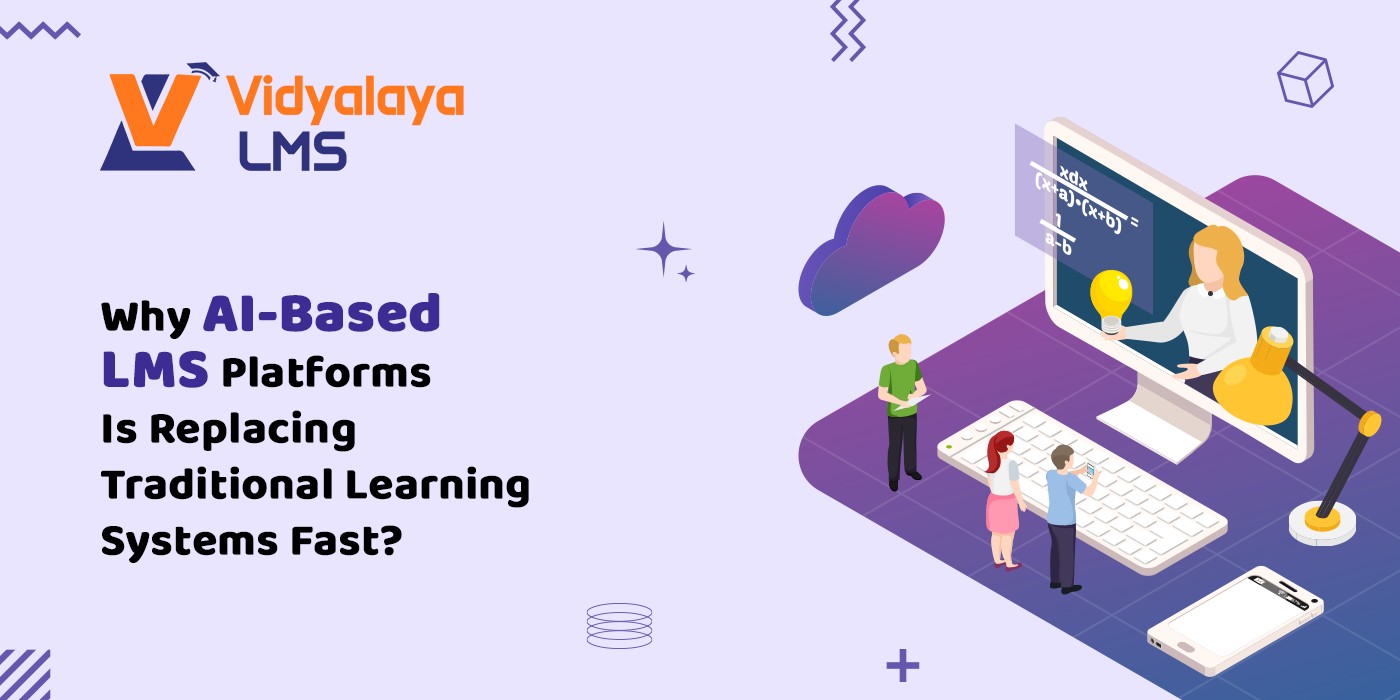
Artificial intelligence has altered the course of educational development and enterprise training by transforming how people learn. The previous forms of education using traditional teaching techniques and the manual method of learning are not sufficient, as the number of people seeking personalized, flexible, and data-oriented environments to learn is increasing. AI-based LMS (Learning Management Systems) platforms are changing the landscape of educational institutions by providing innovative, quicker ways to provide engaging instructional solutions to the educational marketplace.
Organizations across all industries – from K-12 and higher education to private sector employers and training centres – are adopting new instructional technologies to enhance learning outcomes, automate administrative tasks, and create tailored learning environments. Digital Learning is gaining acceptance worldwide as the preferred option over the historically established method (classroom or distance) of providing educational instruction.
This blog post will discuss what is driving AI’s transformation of education, how AI learning platforms improve students’ learning experiences, and why companies are moving away from traditional learning management systems toward AI-driven online learning solutions.
What are AI-based LMS Platforms?
AI Learning management systems (LMSs) are state-of-the-art systems that utilize Artificial Intelligence to automate, personalize, and enhance the learning process. Compared to traditional LMS software, AI-based platforms can evaluate student performance, highlight both strong and weak performance, recommend appropriate content for the student, and provide personalized study plans.
Some examples of what an AI LMS can do are:
- Smart recommendations of courses
- Automated assessment and grading
- Personalized learning experiences
- Performance predictions
- AI-based chatbots to assist students
- Real-time tracking
With an AI LMS in place, organizations and institutions can provide learners with a better overall learning experience and reduce the amount of manual labour required of teachers and administrators.
Limitations of Traditional Learning Systems
Standardized education models and classrooms formed the basis of traditional learning systems. Though traditional systems have benefited educational institutions for numerous years, they do not offer students enough flexibility or personalization.
Key limitations of traditional systems include:
- Lack of student engagement
- One style fits all in terms of how students learn
- Manual reporting and grading
- Tracking student progress can be hard to do
- Limited insight into how students are performing in class daily
- Administrative tasks consume too much time and do not allow for quality teaching
Another issue is that traditional systems are having difficulty adapting to the growth of remote/hybrid learning environments. With changes in the way learners expect to learn, schools need more advanced solutions that are both adaptive and smart.
This is part of the reason that AI-based learning platforms are taking over traditional education systems at an incredibly fast rate.
Benefits of an AI-Powered Learning Management System:-
Integrating artificial intelligence (AI) into a learning management system (LMS) provides varied advantages to educational institutions, businesses, and organisations that offer training.
1. Personalised Learning Experience:
AI can generate individualised learning pathways for each learner based on their ability, preferences, and speed of learning. This leads to higher levels of knowledge retention as well as higher levels of satisfaction from the learner.
2. Increased Learner Engagement:
AI tutors and interactivity via quizzes, gamification, and individualised suggestions help to improve learner engagement and participation.
3. Analytics in Real-Time:
Real-time analytics and instant reporting from AI tools enable educators to easily identify learning gaps and monitor the performance of learners.
4. Automated Administration Tasks:
Administration of tasks such as attendance, student assessments, scheduling, and student/educator communication can be done automatically as opposed to manually, allowing for ease of administration and lessening the administration burden through automation.
5. Improved Learning Outcomes:
Students are provided with not only personalised support but also adaptive content; therefore, they are more able to process information and learning material successfully, resulting in improved performance.
6. Scalability:
AI-powered LMS can accommodate thousands of users at one time, improving scalability; hence, AI-powered LMS is appropriate for use in schools, colleges, and corporate training programs.
AI-Driven Online Learning for Businesses and Schools:
AI is not only changing how educational institutions train their students, but it is also changing how companies provide training to their employees. By using an artificial-intelligence-based Learning Management System (LMS), businesses can efficiently provide employee training and evaluate the progress of each individual employee’s skill set.
Benefits of using AI in companies:
- Onboarding employees faster
- Performing skill gap assessments
- Delivering customized employee training
- Managing certification automatically
- Delivering compliance materials and training
Schools and universities use AI Learning Platforms to improve their student achievement, streamline their administrative processes, and support hybrid learning environments.
With more people wanting to learn online rather than attending an actual school or college, educational institutions must incorporate scalable and intelligent technologies into their business operations to create consistent learning opportunities for all students, regardless of where they are learning.
Future of AI in Education:
Artificial Intelligence is linked to the future of education. The improving nature of technology will allow AI-based LMS Platforms to become more intelligent and adaptive.
Advancements of the future may be:
- AI-generated content
- Voice-activated tutors
- Advanced predictive analytics
- Integration of augmented and virtual reality
- Emotion-based learning assessment
- Completely adaptive digital classrooms
Experts believe that through continued development, the education industry will be changed by AI, enhancing access to learning, efficiency in learning, and personalisation of learning for all students around the globe.
Conclusion:
Artificial Intelligence is reshaping the future of education and training by making learning more personalized, interactive, and efficient. Traditional learning systems are struggling to meet the demands of modern learners who expect flexibility, real-time support, and digital accessibility. AI-based LMS platforms help educational institutions and businesses automate administrative tasks, improve learner engagement, track performance instantly, and deliver customized learning experiences that lead to better outcomes. As online and hybrid learning continue to expand globally, adopting AI-powered learning solutions is becoming essential for long-term growth and success.
For schools, colleges, coaching institutes, and businesses, investing in an intelligent LMS is no longer just an option — it is a strategic step toward future-ready education and training. Vidyalaya LMS provides advanced AI-powered Learning Management System solutions that simplify learning management while enhancing productivity and learner satisfaction. Contact us today for a free demo and discover how Vidyalaya LMS can help you transform your digital learning experience.