







Educational institutions today face increasing pressure to deliver high-quality learning experiences while managing growing administrative responsibilities. Although educators are passionate about teaching and student development, a significant portion of their time is often consumed by repetitive tasks such as lesson planning, assessments, grading, attendance management, and communication. This growing workload can limit productivity and reduce the time available for meaningful classroom engagement, making operational efficiency a top priority for modern schools and colleges.
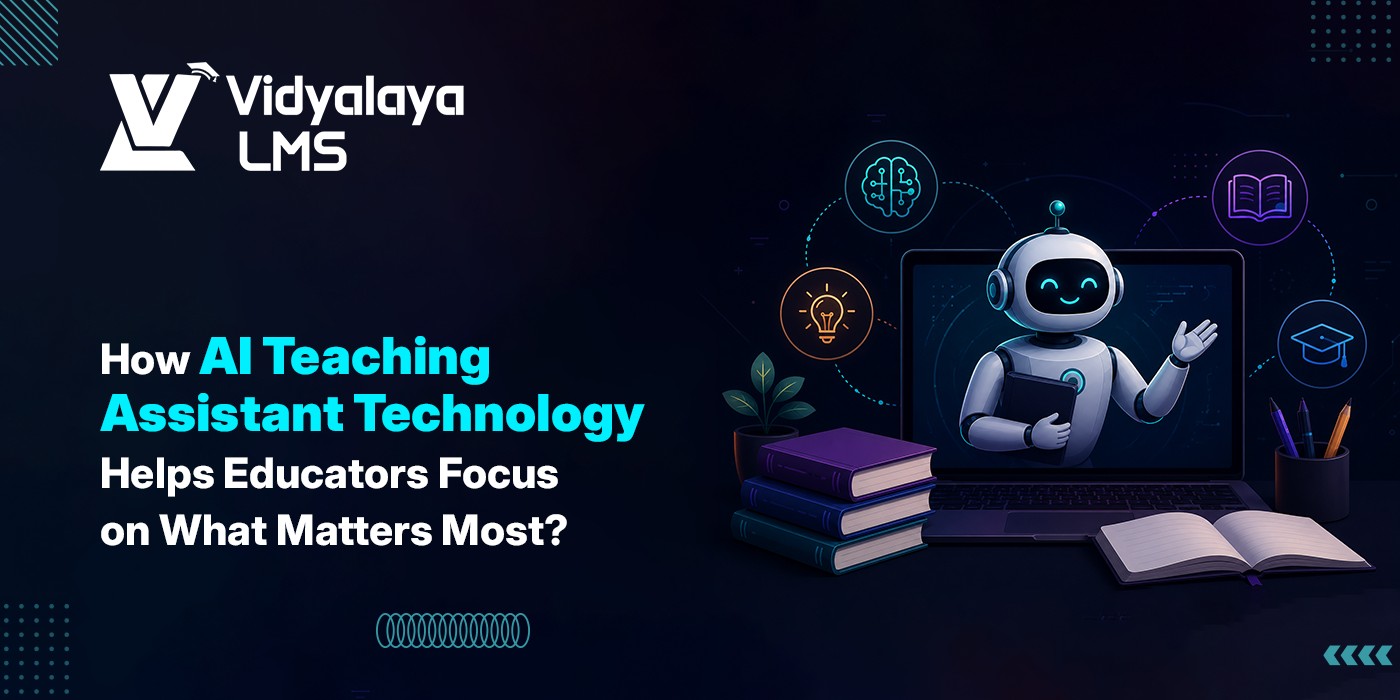
AI Teaching Assistant Technology, supported by AI tools for teachers, is helping institutions address these challenges by automating routine academic and administrative tasks. An AI-powered teaching assistant allows educators to dedicate more time to personalized instruction and student success. When integrated with a comprehensive Learning Management System like Vidyalaya LMS, these intelligent capabilities streamline workflows, improve institutional efficiency, enhance learning outcomes, and support the digital transformation of education.
The Job Underneath the Job:
Teaching, on paper, is instruction. In practice, it’s instruction plus a second, unpaid job: grading quizzes, tracking who’s behind, drafting progress notes, answering the same homework question from six different students, prepping worksheets at three different difficulty levels for one class.
None of that is why anyone became a teacher. It’s also not optional — until a Teaching Assistant, human or otherwise, is absorbing it.
Where an AI Teaching Assistant Actually Helps?
It’s worth getting specific, because “AI helps teachers” as a sentence promises everything and describes nothing.
First-pass grading, not final grading:
An AI Teaching Assistant can mark objective and semi-objective work — quizzes, short answers, structured assignments — instantly, flagging patterns like “eleven students missed the same concept.” A teacher still makes the judgment call on nuance, but they’re not starting from a blank stack of forty papers.
Answering the question before it needs a teacher:
Students ask the same handful of questions every week: what’s due, what does this term mean, where’s the extra practice. An AI Education Assistant handles that layer directly, so a teacher’s time goes to the question that needs their explanation, not the one that’s just repetitive.
Differentiated material without starting from scratch:
Building three versions of one worksheet for three skill levels used to mean three separate drafting sessions. AI for Teachers tools can generate those variations from a single source, leaving the teacher to review and adjust rather than build from zero.
Drafting the paperwork, not deciding it:
Progress notes, parent updates, lesson plan documentation — a first draft that a teacher edit is a different task than writing one from scratch at 9 PM.
Why This Sits Inside a Bigger Shift in AI in Education?
An AI Teaching Assistant working alone is useful. One connected to a school’s actual data — attendance, past performance, assignment history — is a different order of useful, because it stops guessing and starts responding to what’s happening with a specific student.
That’s the direction AI in Education is heading generally: less about a chatbot answering generic questions, more about a system that notices a student’s quiz scores dipped on one topic and flags it before a teacher would have caught it three weeks later during report card season.
What Schools Get Wrong When They Bring This In?
The most common mistake is treating an AI Teaching Assistant as a replacement rather than a filter. Framed that way, teachers understandably resist it — nobody wants their expertise handed to software. Framed correctly, as the thing absorbing the repetitive 40% so the teacher’s time goes to the 60% that needs them, adoption looks completely different.
The second mistake is rolling it out everywhere at once. A teacher drowning in ungraded quizzes and one buried under parent emails need different first wins. Starting narrow — grading support for one subject, say — and expanding once trust is built works better than a school-wide mandate on day one.
Where This Goes Next?
The next stage isn’t a smarter chatbot in the corner of a learning app. It’s an AI Teaching Assistant Technology that quietly tracks patterns across a whole class — who’s disengaging, who’s ready for harder material, who needs a check-in — and surfaces that to a teacher as a short, actionable note instead of a wall of data they have to interpret themselves.
The goal was never to make teaching a smaller job. It’s to make sure the hours in a teacher’s day go toward the parts only a teacher can do.
Conclusion:
As educational institutions continue to embrace digital transformation, adopting AI-powered solutions is no longer just an innovation—it’s a strategic investment in improving academic excellence and operational efficiency. With the help of advanced AI education software, institutions can reduce administrative workloads, enhance teaching productivity, and enable data-driven decision-making. AI Teaching Assistant Technology empowers educators to focus on what truly matters: delivering personalized learning experiences and supporting student success. This approach helps schools and colleges build a smarter, more connected, and future-ready learning environment.
Vidyalaya LMS combines intelligent automation with a comprehensive Learning Management System to help institutions simplify academic operations, improve educator efficiency, and deliver better learning outcomes. Whether you’re planning to modernize classroom management or enhance institutional productivity, our solution is designed to support your digital transformation journey. Contact us today for a free demo and discover how our AI-powered platform can help your institution achieve greater efficiency and educational excellence.