





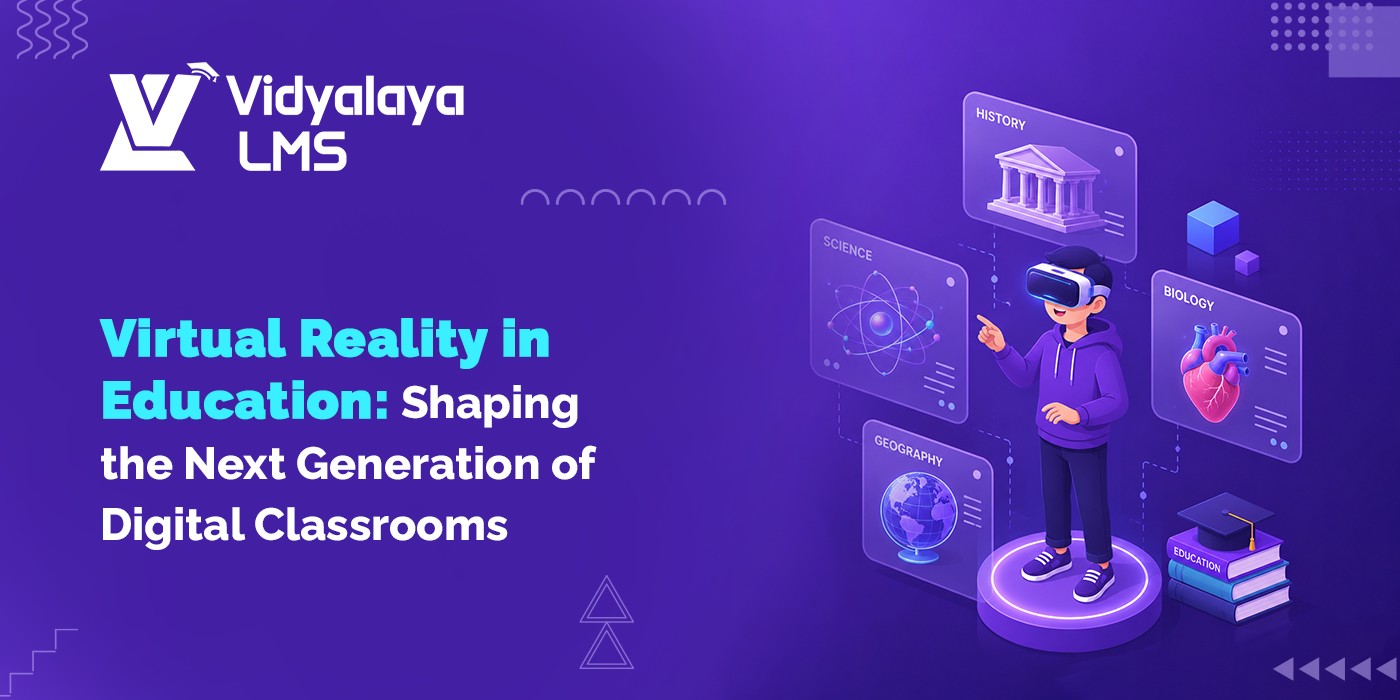
Virtual Reality in Education: Shaping the Next Generation of Digital Classrooms

Vidyalya LMS

The education sector is embracing digital transformation, and Virtual Reality in Education is becoming a key innovation that enhances the learning experience. Instead of relying only on textbooks and recorded lectures, learners can explore immersive environments, perform practical simulations, and gain hands-on knowledge. This modern approach improves engagement, strengthens concept clarity, and supports better learning outcomes across academic and professional training.

As institutions adopt advanced digital solutions, VR Learning Platforms are helping educators deliver interactive and skill-based learning experiences. When integrated with a robust Learning Management System(LMS) like Vidyalaya LMS, these technologies simplify content delivery, learner tracking, and course management while creating smarter, more engaging digital classrooms for the future.

What Is Virtual Reality in Education?

Virtual Reality in Education refers to the use of immersive virtual environments to enhance teaching and learning. By wearing VR headsets or using compatible devices, learners can experience simulated environments that make learning more interactive and engaging. 

Educational institutions use VR technology for:

  • Virtual science laboratories 
  • Historical site exploration 
  • Medical and healthcare simulations 
  • Engineering and technical training 
  • Language learning 
  • Corporate skill development 

These experiences help learners better understand concepts through practical interaction. 

How the Implementation of VR in Education Will Change Learning?

The implementation of VR in Education will bring about changes to the way students approach their learning.

1. Increased Student Engagement

Interactive environments will keep students interested and motivated throughout the learning experience.

2. Enhanced Information Retention

Practical experiences will aid in information retention better than conventional lecturing.

3. Risk-Free Practical Experience

Learners can gain practical experience without putting themselves in any physical danger.

4. Education in Virtual Locations

Learning becomes more accessible due to the creation of virtual worlds and experiences. 

Advantages of Virtual Reality Learning

There are multiple benefits of Virtual Reality Learning for educational institutions and organizations. 

Interactive Learning 

Students interact with the learning material rather than just being passive listeners. 

Better Concept Clarity 

Difficult concepts can be learned better through visualization and simulation. 

Boosted Self-Confidence 

Students gain confidence after practicing in virtual scenarios before implementing it practically. 

Collaborative Learning 

Virtual classrooms promote collaborative activities. 

Role of a VR Learning Platform

A modern VR Learning Platform combines virtual reality experiences with learning management capabilities. 

It enables organizations to: 

  • Deliver immersive learning content 
  • Track learner participation 
  • Monitor training progress 
  • Conduct assessments 
  • Manage digital learning resources 
  • Provide personalized learning experiences 

This integration helps institutions combine immersive technology with structured learning management. 

Challenges in Adopting VR for Education

Although VR offers significant benefits, organizations may face challenges such as: 

  • Initial investment in hardware 
  • Development of VR learning content 
  • Device compatibility 
  • Teacher training 
  • Internet and technical infrastructure 

As technology becomes more affordable, these challenges are gradually becoming easier to overcome. 

Future of Virtual Reality in Education

The future of education will be more immersive and student-centered. With the advancement in virtual reality, organizations will offer more simulations, learning using artificial intelligence, and virtual classrooms. 

In addition to cloud computing, VR will revolutionize education through the protocolization of the learning process. 

Conclusion

As educational institutions continue to embrace digital transformation, integrating virtual reality with a powerful Learning Management System is becoming essential for delivering engaging, interactive, and future-ready learning experiences. By adopting Educational Virtual Reality, schools, colleges, universities, and training organizations can improve learner engagement, simplify practical training, and create personalized learning journeys while efficiently managing courses, assessments, and learner progress through a centralized platform.

At Vidyalaya LMS, we help educational institutions leverage the latest learning technologies with a comprehensive LMS designed to support immersive and scalable digital education. Whether you’re looking to enhance online learning, streamline academic management, or prepare your institution for the future of education, our solution is built to meet your evolving needs. Contact us today for a free demo and discover how Vidyalaya LMS can transform your digital classroom experience.

Frequently Asked Questions

1. How does immersive technology improve student learning? 

Immersive learning allows students to experience concepts in a practical and interactive way instead of only reading or watching content. This approach increases engagement, improves understanding, and helps learners retain knowledge more effectively.

2. Which educational institutions benefit the most from immersive learning solutions? 

Schools, colleges, universities, coaching institutes, and corporate training organizations can all benefit from immersive learning. It is particularly valuable for courses that require practical demonstrations, simulations, and skill-based training.

3. Is virtual learning technology suitable for remote and hybrid education?

Yes, immersive learning solutions support remote and hybrid education by allowing learners to access interactive training experiences from different locations. This creates a more engaging digital learning environment while maintaining learning consistency.

4. What factors should institutions consider before adopting immersive learning solutions?

Organizations should evaluate their learning objectives, technology infrastructure, budget, device compatibility, and faculty readiness. Proper planning ensures successful implementation and maximizes long-term educational benefits.

5. How can a Learning Management System support immersive education?

A Learning Management System helps institutions organize courses, deliver digital content, track learner progress, conduct assessments, and manage reports. When combined with immersive learning experiences, it creates a structured and efficient digital education ecosystem.

6. Can immersive learning be used for professional and corporate training?

Yes, businesses can use immersive learning for employee onboarding, technical training, safety simulations, compliance programs, and leadership development. It provides realistic practice environments that improve workforce readiness and skill development.

7. How does Vidyalaya LMS support modern digital learning initiatives?

Vidyalaya LMS provides a centralized platform for managing courses, assessments, learner progress, communication, and reporting. Its scalable features help educational institutions deliver engaging and efficient digital learning experiences.

8. Why should educational institutions choose Vidyalaya LMS?

Vidyalaya LMS offers comprehensive learning management features that simplify academic administration while supporting modern teaching methodologies. It enables institutions to enhance learner engagement, improve operational efficiency, and scale digital education with ease.

author

The Author

Kumaril Patel

CEO & Co-Founder

LinkedIn Icon

Kumaril Patel is the CEO & Co-Founder of Sapphire Software Solutions, a global technology company specializing in software, mobile app, and web development. With over 20 years of diverse IT leadership, he has built international business operations from the ground up and led the leading flagship digital platforms such as Vidyalaya School Management System and OccuCare Occupational Health Management System.

Kumaril is known for transforming ideas into high-impact technology solutions—leading cross-functional global teams and building innovation-driven ecosystems. His strategic vision has enabled long-standing collaborations with global enterprises including American Express, Bayer, TATA Group, Adani Group, Larsen & Toubro, Honda, Toyota and Vedanta Limited.

Passionate about innovation, AI, and cloud technologies, Kumaril focuses on empowering organizations to scale globally while solving real-world challenges through transformative digital solutions.

Related Blog

sapphire
December 30, 2025 5 min read
Organizations and educational institutions increasingly depend on remote learning and e-learning to support a geographically distributed workforce and student base. As teams and learners operate from multiple locations, traditional methods of measuring productivity and training effectiveness have evolved. However, simply shifting existing training programs to an online format does not automatically lead to improved performance or engagement. Productivity gains are achieved only when remote learning is delivered through a well-structured, goal-oriented Learning Management System (LMS) designed to support efficient skill development and measurable outcomes. A Learning Management Software serves as a centralized platform for delivering, managing, and tracking online educational […]
Read More Vidyalaya LMS
sapphire
October 21, 2024 4 min read
Online education, then, can serve two goals. For students lucky enough to have access to great teachers, blended learning can mean even better outcomes at the same or lower cost. And for the millions here and abroad who lack access to good, in-person education, online learning can open doors that would otherwise remain closed. – Daphne Koller. The importance of e-learning is summarized in the above statements. And market figures are even proving it right. According to the latest news, the e-learning market is expected to exhibit a growth rate of 8.3% CAGR during 2024-2032. The moral of all the above is that embracing e-learning […]
Read More Vidyalaya LMS