







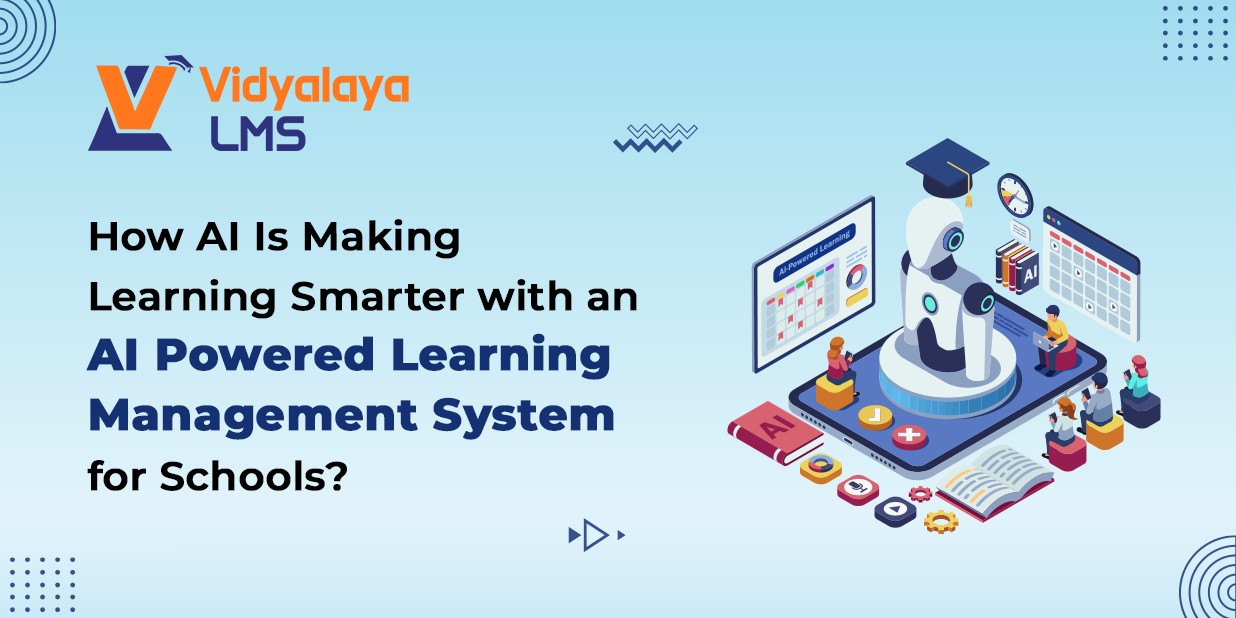
Education is rapidly evolving as schools embrace digital transformation to create more connected, personalized, and outcome-driven learning experiences. Traditional teaching methods centred around textbooks, classroom instruction, and standardized assessments are increasingly being complemented by intelligent digital solutions. An AI-powered Learning Management System (LMS) for schools enables educational institutions to streamline academic processes, improve learner engagement, and support teachers with data-driven insights, creating a smarter and more efficient learning environment.
However, simply digitizing educational content is not enough to meet the evolving needs of modern schools. An AI-powered LMS can go beyond online classes and course management by analyzing learner performance, identifying learning patterns, supporting personalized learning paths, and providing actionable insights for educators. By integrating Artificial Intelligence into learning management, schools can make informed academic decisions, enhance teaching effectiveness, and deliver more personalized learning experiences while improving overall educational outcomes.
The Shift Toward Smarter Digital Learning
Conventional digital learning solutions tend to emphasize the delivery of the content. Learners enter their accounts, get lessons, complete homework and pass quizzes. Although this makes the process convenient, each learner can get virtually the same experience.
AI provides an added intelligence to this process.
Rather than assuming that all learners should be treated equally, AI technology can monitor the process of learning and determine where students differ. The learner who is moving fast might require new challenges, while the other student would benefit from revisions or supplementary materials.
This makes digital learning adaptive and helps teachers make more informed decisions.
How AI Is Changing the Learning Experience?
There are various ways in which AI can be utilized in helping learners learn. AI can help analyze learner data, recognize patterns, suggest content, and give information that may take longer for teachers to come across manually.
For instance, if a learner consistently fails in a certain subject, the software can assist in recognizing such a pattern, whereafter the teacher can offer extra assistance even before there is a bigger gap in learning.
Another way in which AI can help students is through offering a personalized learning experience based on learners’ performance and progress. The intention here is not to take the place of teachers but to offer them a support tool in terms of offering insight into what happens in their classroom
Why Schools Need a Learning Management System for Schools?
Learning Management System for Schools in the modern age is an ecosystem where all digital learning activities are managed from a single place.
The addition of AI capabilities to such an ecosystem means that the system will not be limited to just being a database of digital contents.
Rather, it would enable the school authorities to know how well students are utilizing the learning contents, what aspects need more focus and effort. In this way, there will be greater integration between teaching, learning, assessing, and learning outcomes
Personalized Learning for Every Student
One of the biggest advantages of AI in education is personalization. Students do not all learn at the same speed or in the same way. Some may understand a topic after one explanation, while others may need examples, practice questions, videos, or additional revision.
An ai powered learning management system can use available learning and performance information to support a more personalized learning experience.
For example, students who demonstrate difficulty with a topic can be directed toward additional practice or supporting resources. Students who are progressing well can continue to more advanced activities. This can make learning less one-size-fits-all and more aligned with individual student needs.
Smarter Assessments and Performance Insights
There are many ways where the application of AI could help in making a real difference.
In most cases, teachers need to assess large numbers of performance data for their students. Assessment of individual results is helpful, but the analysis of trends from multiple assessments is very tedious.
The role of AI in this case could be helpful in terms of sorting out and analyzing the data to find performance trends, weak spots of students and provide a broader perspective of academic performance. It would allow educators to get past simple questions about passing or failing and get more insights into what students know and need to improve.
Supporting Teachers with Intelligent Insights
AI is not only valuable for the student’s side but also for the teachers. The process of preparation of learning materials, assignments reviews, monitoring of progress and identification of learners requiring special attention occupies teachers for a lot of time.
The introduction of AI can help automate some routine processes through information organization and analysis of relevant information.
For instance, teachers do not have to check several reports looking for learners having poor results. They will be able to analyze insights generated by the platform.
Making Online Learning More Interactive
An Online Learning Management System gives students access to educational resources beyond the physical classroom. They can access lessons, assignments, assessments, videos, and other digital resources according to the school’s learning structure.
AI can make this experience more interactive by helping personalize content and learning activities. Students can learn at their own pace, revisit difficult topics, and access resources when they need additional practice. This flexibility can be particularly useful for blended learning and digital-first education models.
Important Learning Management System Tools Enhanced by AI
Modern platforms include a wide range of learning management system tools that support teaching and learning. These may include course management, assignments, quizzes, assessments, content sharing, learner tracking, reports, and communication features.
AI can make these tools more useful by adding intelligence to the information they generate.
For example:
- Learning activity can be analyzed to understand engagement.
- Assessment results can reveal performance patterns.
- Student progress can be monitored over time.
- Learning resources can be better aligned with individual needs.
- Teachers can receive insights into areas requiring attention.
- Administrators can gain a broader understanding of learning outcomes.
The combination of these capabilities creates a more connected digital learning environment.
AI-Powered Learning and Student Engagement
Engagement of the students is another major challenge in the digital learning process. Just putting up online material does not ensure that the learners will engage with it.
The technology of AI can help the institutions understand the patterns of engagement by analyzing the elements like activity of the course, participation in assessments, and interaction with content. If the educators have more insight into these patterns, then they can act on them and help the learners who have dropped off or who are lagging.
This way, technology not only helps in imparting education but also in engagement of the students.
The Future of AI-Powered Learning
The use of AI will keep affecting the way schools are providing education. The future learning tools are expected to be even more personalized, predictive, and interactive.
There will be more opportunities for adaptive learning, for teachers to get performance insights, and for schools to make more informed academic decisions using learning data. Nevertheless, the use of technology will always be just a supplement. The crucial role of teachers, mentors, and educators will not go away because real education implies much more than data and scores.
The best schools will be those who will utilize the power of AI to enhance the synergy of technology and teaching.
Conclusion:
An AI-powered Learning Management System is becoming an important part of modern school education, helping institutions move beyond basic content delivery toward smarter, personalized, and data-driven learning. From understanding student performance and identifying learning gaps to supporting teachers and improving engagement, AI can make LMS platforms more intelligent and effective. With the right technology, schools can create a connected learning environment where students receive the support they need, teachers gain actionable insights, and administrators can make better-informed academic decisions.
As education continues to evolve, adopting an AI-powered LMS can help schools build a more flexible, efficient, and future-ready digital learning ecosystem. Vidyalaya LMS provides schools with intelligent learning management capabilities designed to support personalized learning, academic monitoring, assessments, and effective digital education management. Contact us today for a free demo and discover how Vidyalaya LMS can help your institution transform the way it manages and delivers learning.