







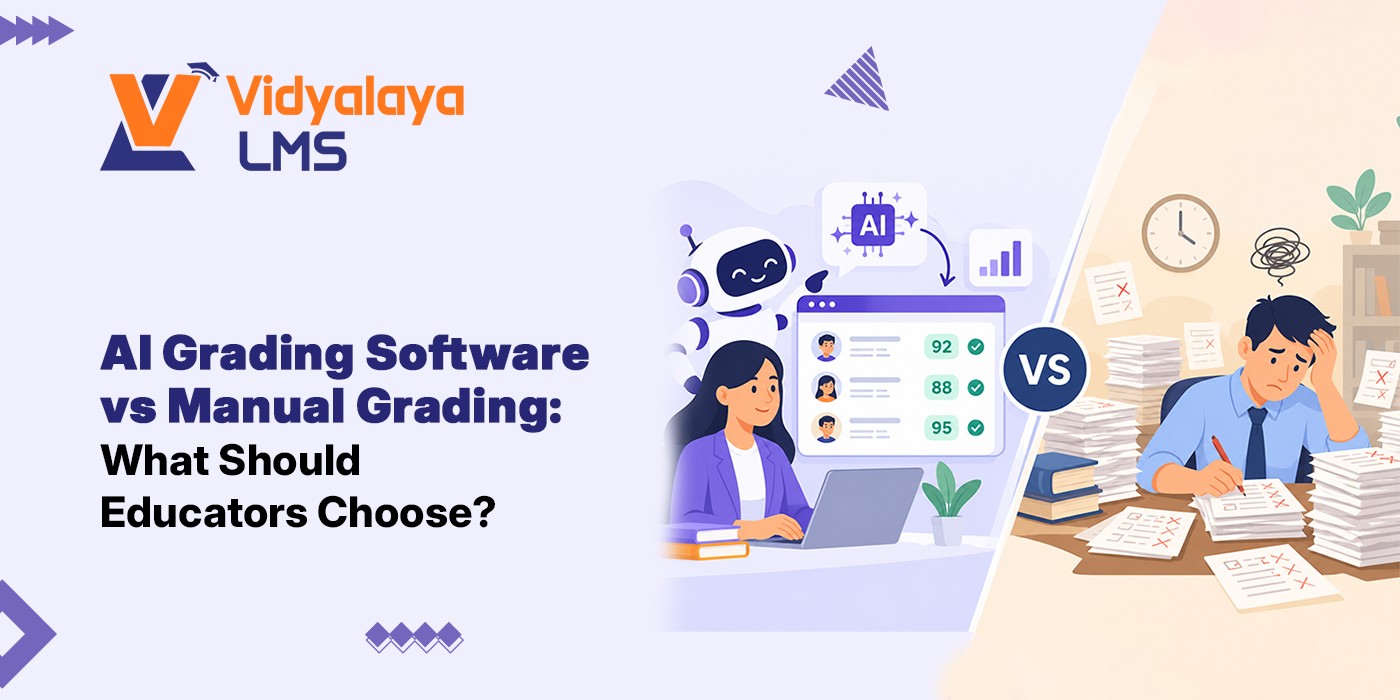
Assessment plays a crucial role in measuring student performance, identifying learning gaps, and improving educational outcomes. However, traditional manual grading can be time-consuming for teachers, particularly when evaluating large volumes of assignments, tests, and examinations. AI Grading software offers an efficient alternative by automating repetitive evaluation tasks, accelerating feedback delivery, and supporting data-driven academic decisions.
As schools, colleges, and universities increasingly adopt digital learning solutions, choosing between AI grading software and manual grading has become an important consideration. While manual grading offers human judgment and contextual understanding, AI-powered assessment tools can improve evaluation efficiency and reduce educators’ administrative workload. In this blog, we will compare AI grading vs manual grading, explore their key advantages and limitations, and explain how educational institutions can combine both approaches to create a more efficient, accurate, and learner-centric assessment process.
What Is AI Grading?
AI grading is the utilization of machine learning and artificial intelligence to assist in the assessment of different student responses. These systems are of varying capacities, which may include automatic grading for objective questions, textual analysis of written responses, and informative feedback generation. AI grading techniques make it easier for multiple forms of assessment such as online test and quiz evaluations, multiple-choice testing, and even certain types of essays.
For instance, the teacher may use an automatic grading mechanism to grade objective replies in an online quiz on science.
Some possible uses of AI grading tools are:
- Automatic assessment: Grading of different types of objective questions.
- Instantaneous feedback: Providing students feedback close to the time of taking the test.
- Grading according to a specific rubric: Grading students’ writing based on given parameters.
- Analysis of performance: Finding out which questions are frequently missed.
Nevertheless, AI-generated solutions may not always work. In cases where subjective answers are provided, additional attention may be necessary.
What Is Manual Grading?
Manual grading is an assessment method that is conventional in nature wherein teachers themselves evaluate students’ answers and award marks as per assessment criteria. Manual grading is still commonly employed in written tests, assignments, essays, presentations, projects, and other assessments which require interpretation and judgment.
In manual grading, a teacher evaluates why an answer was given, the way student dealt with a particular problem, as well as quality of explanation given by student.
Some of the main traits of this assessment method are:
- Personalized assessment based on teachers’ understanding of the subject.
- A certain degree of flexibility in the assessment of independent opinions and unconventional ideas.
- Individualized feedback for students.
- A clear distinction of misunderstanding achieved as the result of thorough evaluation.
- An extensive amount of time and labour invested in the assessment of huge number of submissions.
Even though manual grading helps assessors get precise information, it is important to bear in mind the fact that there cannot be consistency in evaluation because workload, assessment criteria, and evaluation methods differ from person to person.
Key Benefits of AI Grading Software
Assessment with AI grading software becomes simpler since it performs monotonous tasks giving the way to the educator’s teaching focus.
Rapid Score Processing
AI evaluations can easily process multiple-choice tests much faster than traditional grading procedures. As a result, evaluation is done, and students can get their scores immediately after the completion of the exam.
Consistent Scoring
If the AI system is properly set, machine-based grading provides massive assessment through the application of the same answer keys, rubrics, and grading scales providing less variance in regular grading.
Helpful Insights for Teaching
AI assessment instruments enable the teacher to identify common mistakes and control the learning process of students.
Less Teacher Workload
Using automatic grading system automation diminishes teachers’ hard work as they can concentrate on the planning process and interactions with students.
UNESCO’s International Report on Education 2023 confirms that tech support can enhance education only when applied in a reasonable, fair, and efficient manner, which highlights the significance of using assessment technologies.
Advantages of Manual Grading
Even with high tech advancements, manual evaluation plays a significant role in different types of evaluation.
Its key benefits are as follows:
- Human judgment: Trained professionals can understand various aspects of the context, argumentation, and possible answers.
- Personalized feedback: Educators can give explanations of wrong answers and provide recommendations for improving the answer.
- Creative evaluation: Human judgment is particularly needed in evaluating students’ essays, research papers, and open-ended assignments.
- Flexibility: Manual scoring allows teachers to look not only at the answer but also at the learning process.
- Building relationships: The process of evaluating students’ papers helps teachers to understand the strengths and weaknesses of each student.
For example, an average student may solve a math problem successfully but by using different methods. The teacher will notice both techniques and acknowledge their validity even if they are not in line with the accepted one.
These examples show that manual evaluation can be extremely useful when evaluation requires deeper insights into students’ thinking
AI Grading vs Manual Grading: Key Differences
Efficiency and human judgment are at the root of the distinction.
- Speed: With AI grading, objective tests can be graded in less time than with human grading.
- Consistency: The AI grading method is uniform in its use of rules while the human grading technique can lead to varying results depending on different evaluators.
- Subjectivity: Although AI can give the proper feedback immediately and uniformly, a teacher’s evaluation of arguments and creativity is better.
- Feedback: While AI gives more immediate feedback, teachers provide customized guidance.
- Costs: Although AI grading can help to save time and resources, institutions want to be certain they can afford the software’s licensing, implementation, and maintenance costs before investing in technology.
- Dependability: Both methods are liable to errors. AI should be monitored whereas human evaluators are subject to various causes of error.
None of the two approaches is considered superior. The selection of one or another option depends on the assessment type, institutional requirements, and the importance of human involvement in grading.
The Future of Student Assessment
Education would be followed by increased cooperation between educators and intelligent technologies in future assessment practices. Utilizing AI-based learning platforms may allow for automating simple assessment tasks, recognizing students’ performance trends, and determining assessment results faster. Such information would help teachers make necessary changes in their classes and provide more assistance to struggling students.
However, the responsible implementation of such practices is paramount. Educational institutions need to test the accuracy of the obtained results, formulate evaluation criteria, secure students’ records, and conduct human review of significant assessments.
The main aim here automatic grading software is to not substitute teachers but to supply them with better tools for teaching purposes.
Conclusion
Choosing between AI grading software and manual grading depends on an educational institution’s assessment needs, class size, academic goals, and available resources. While AI-powered grading systems help automate repetitive evaluations, deliver faster feedback, and streamline assessment workflows, manual grading remains essential for evaluating creativity, critical thinking, and subjective responses. By combining AI grading technology with educators’ expertise, schools, colleges, and universities can improve assessment efficiency, maintain evaluation quality, and create a more effective and student-centric learning environment.
Vidyalaya LMS helps educational institutions embrace digital learning and streamline academic processes through technology-driven solutions. If your institution is looking to simplify assessments, reduce teachers’ workloads, and enhance the overall learning experience, adopting the right Learning Management System (LMS) can be a valuable step forward. Contact Vidyalaya LMS today to book your free demo and discover how our LMS solution can support your institution’s digital transformation and help you deliver a more efficient, engaging, and organized learning experience.