








The way employees learn and grow at work is evolving faster than ever. With hybrid workplaces, globally distributed teams, and the rapid pace of technological change, organizations face the challenge of engaging employees whose attention spans are shorter and whose expectations are higher. In this new reality, staying ahead of eLearning trends is no longer optional—it’s essential for businesses that want to remain competitive, agile, and innovative.
As we enter 2026, companies that fail to adopt the latest corporate eLearning trends, digital learning strategies, and online training technologies risk falling behind in employee upskilling, talent retention, and overall business performance. In this blog, we explore the key trends shaping the future of workplace learning, highlighting strategies already transforming real organizations, LMS platforms, and learning teams across industries.
This isn’t speculation—these trends are actively driving results in companies that embrace them, proving that strategic digital learning is a critical business advantage.
Why eLearning Trends Matter More in 2026?
Corporate training used to be simple: classroom sessions, PowerPoint slides, and annual workshops. Today, employees expect learning to be:
- Personalized
- On demand
- Mobile-first
- Relevant to real work
The trend towards digital learning is being driven by trends in technology for education, developments in LMS (Learning Management Systems), and the fast growth and utilization of artificial intelligence technologies within the field of eLearning. Organisations embracing these trends are experiencing increased employee engagement, the ability to develop skills at a quicker rate,e and improved return-on-investment (ROI) with their training budget.
Top eLearning Trends 2026 Every Company Should Watch:-
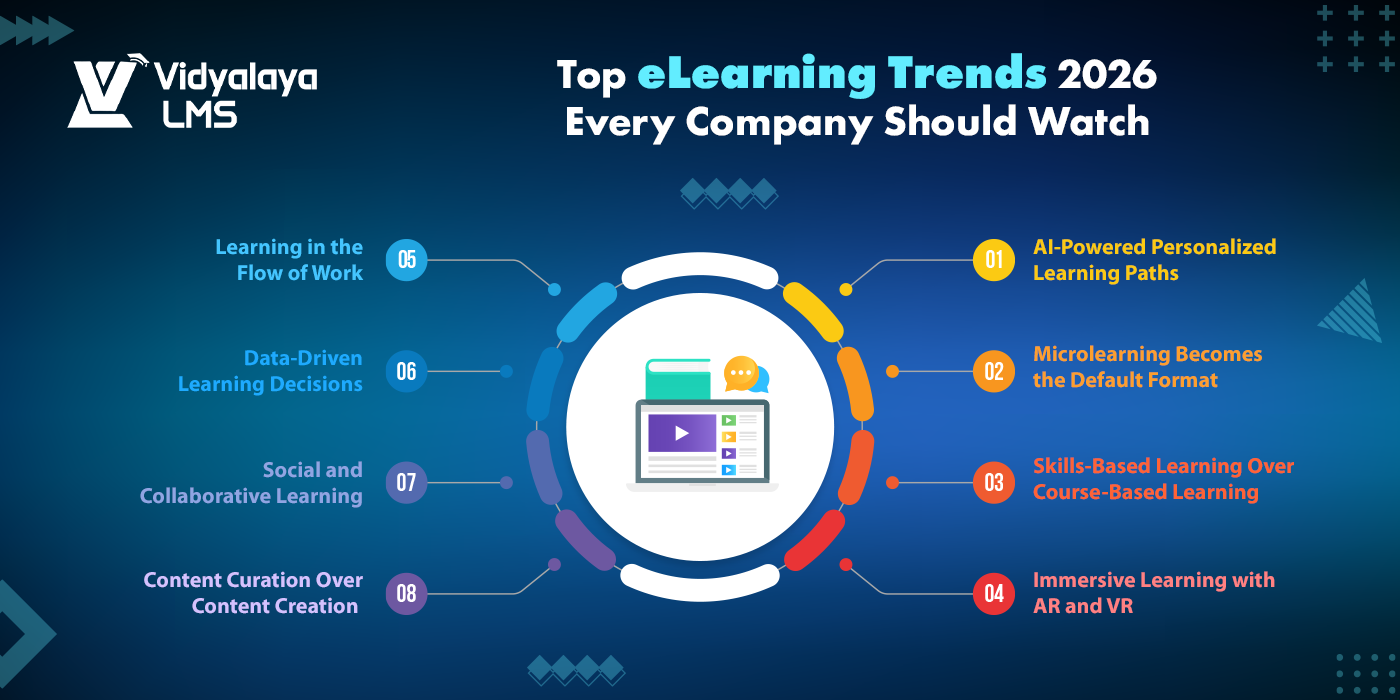
1. AI-Powered Personalized Learning Paths:
AI is no longer experimental. One of the strongest AI trends in eLearning is personalization at scale. Learning platforms now analyse behaviour, job roles, and performance to recommend content automatically.
This trend represents the intersection of digital learning trends and technology trends in education. Employees no longer waste time on irrelevant modules.
Why it matters for companies:
- Faster onboarding
- Better skill matching
- Higher completion rates
2. Microlearning Becomes the Default Format:
Short, focused lessons are dominating online learning trends. Employees prefer 5–10-minute modules over hour-long courses.
Microlearning supports:
- Mobile learning
- Just-in-time training
- Continuous learning cultures
This is one of the most practical eLearning industry trends driven by modern work habits and technology trends in education.
3. Skills-Based Learning Over Course-Based Learning:
In 2026, companies are shifting from “course completion” to “skill mastery.”
Learning platforms now map:
- Skills gaps
- Job competencies
- Career pathways
- This aligns directly with the future of eLearning, where learning is measurable and business-driven.
4. Immersive Learning with AR and VR:
Immersive learning is no longer limited to large enterprises. AR and VR are emerging technology trends in education that enhance safety training, simulations, and complex skill development.
This is one of the fastest-growing digital learning trends within the eLearning industry trends landscape.
5. Learning in the Flow of Work:
Employees don’t want to “leave work” to learn. One major shift in online learning trends is embedding learning directly into tools like Slack, Teams, and CRM systems.
This reflects modern LMS trends and reinforces the future of eLearning as frictionless and contextual.
6. Data-Driven Learning Decisions:
Analytics are becoming smarter. Modern LMS platforms track:
- Engagement
- Skill progress
- Performance impact
This data-first approach defines current eLearning Trends and is driven by measurable outcomes.
7. Social and Collaborative Learning:
Learning is becoming social again — but digitally. Discussion boards, peer learning, and community-driven content are key digital learning trends.
These eLearning industry trends improve retention and knowledge sharing across organizations.
8. Content Curation Over Content Creation:
Instead of building everything from scratch, companies are curating high-quality external content. This trend is reshaping online learning trends and LMS trends.
Curation saves time, reduces cost, and keeps learning current with fast-moving technology trends in education.
9. Compliance Training Gets Smarter:
Compliance is still mandatory, but it’s becoming adaptive and sscenario-based This reflects both AI trends in eLearning and corporate eLearning trends focused on engagement.
Key eLearning Trends Comparison:
|
Trend Area |
Old Approach |
2026 Approach |
| Content | Long courses | Microlearning |
| Learning Style | One-size-fits-all | Personalized AI paths |
| Delivery | Classroom-based | Digital-first |
| Measurement | Completion rates | Skill mastery |
| Platforms | Basic LMS | Intelligent LMS |
How LMS Trends Are Shaping Corporate Learning?
Modern LMS trends focus on:
- AI recommendations
- Mobile optimization
- Integration with business tools
- Advanced analytics
These LMS trends directly support evolving corporate eLearning trends and the broader future of eLearning.
Role of AI Trends in eLearning:
Among all technology trends in education, AI stands out. Key AI trends in eLearning include:
- Chatbots for learner support
- Automated assessments
- Predictive skill analytics
- Smart content tagging
Conclusion:
As we move further into 2026, it’s clear that the landscape of corporate learning is evolving at an unprecedented pace. Companies that embrace these eLearning trends—from AI-powered personalized learning and microlearning to immersive AR/VR experiences and data-driven decision-making—will gain a significant competitive advantage. Organizations that adopt modern LMS platforms, integrate learning into the flow of work, and foster a continuous learning culture are better positioned to upskill employees efficiently, improve engagement, and drive measurable business results.
Staying ahead in the digital learning space is no longer optional; it’s a strategic imperative for growth and talent retention. Vidyalaya LMS empowers businesses to leverage these trends with a smart, scalable, and intuitive platform that meets the evolving needs of modern learners. Contact us today for a free demo and discover how your organization can transform its learning strategy to stay competitive and future-ready in 2026.