







The field of education is currently undergoing significant changes, and technology is at the forefront of driving them. Some of the most notable technological advancements in this field include AI-based solutions in education that have revolutionized the learning process.
Modern institutions are now combining systems like Education ERP with LMS, enabling seamless management of both academic and administrative functions. With the growing demand for digital learning, solutions such as LMS for higher education. Additionally, LMS integration with advanced AI tools for education is making learning more adaptive and data-driven. Learning is not restricted anymore to the conventional classroom environment. Modern learners demand a dynamic and personalized educational experience. Educational institutions have therefore come up with technological innovations aimed at improving the learning process as well as making administrative work easier.
Artificial intelligence forms one of the major innovations that have brought about change. Incorporating artificial intelligence into the learning process will see tasks being automated, the behavior of learners being analysed, and a personalized learning experience being provided. This blog will focus on how institutions can incorporate such technologies.
What Are AI Tools for Education?
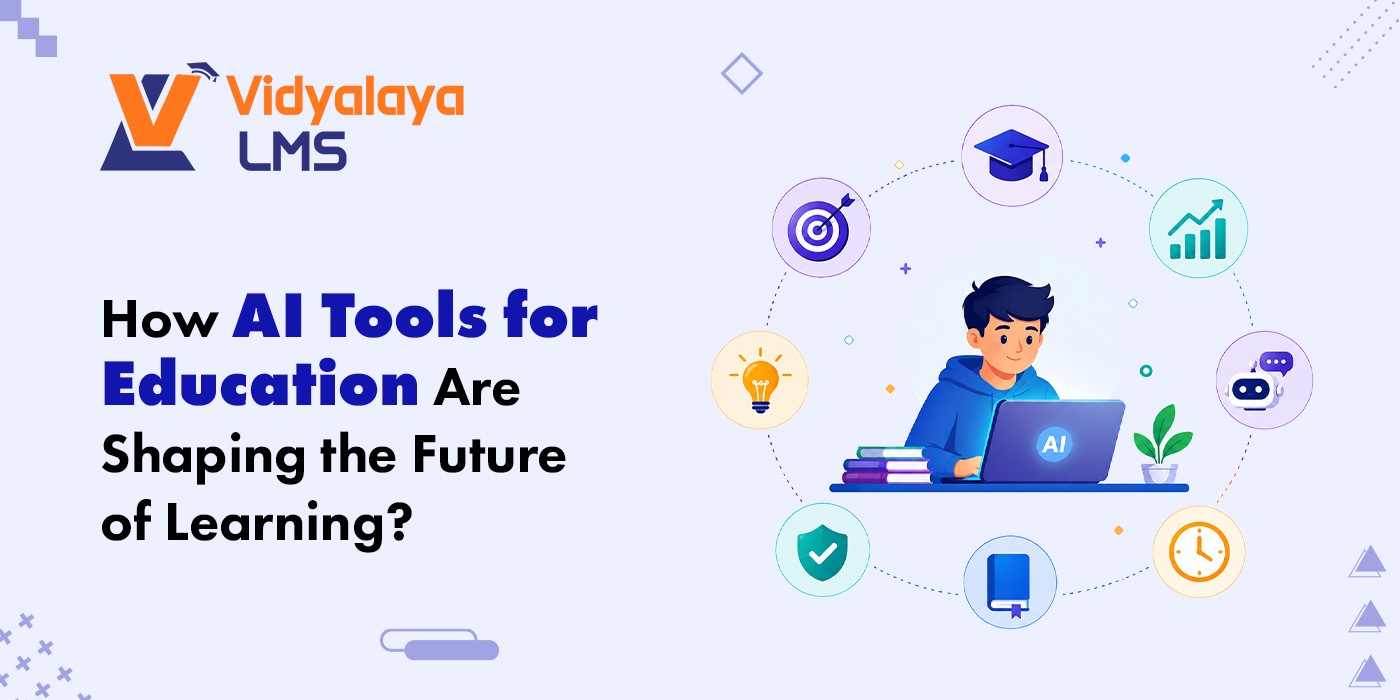
Education-based AI solutions are computer applications that leverage AI to enhance education-related activities. The tools make use of data, automation of processes, and other functions that help users to learn more effectively.
Key functionalities are as follows:
- Personalized learning suggestions
- Automated marking and assessment
- AI-driven content delivery
- Smart real-time monitoring
These capabilities make learning more efficient and tailored to individual needs.
Role of Education ERP with LMS in Modern Learning:-
A powerful Education ERP with LMS combines academic management with digital Learning platforms. The integration of these components enables organizations to handle admissions, attendance, communication, and course content within a single platform.
Advantages are:
- Centralized data management
- Smooth interdepartmental communication
- Increased efficiency
- Monitoring of student performance
By combining ERP and LMS, institutions can create a unified and efficient learning ecosystem.
Importance of LMS for Higher Education and Colleges:
Higher education institutions require scalable and flexible systems to manage large numbers of students and courses. This is where LMS for higher education and LMS for colleges become essential.
These systems help:
- Deliver online and hybrid learning programs
- Manage course content and assignments
- Track student progress and performance
- Facilitate collaboration between students and faculty
Such platforms ensure that institutions can provide quality education while maintaining operational efficiency.
How LMS Integration Enhances Learning Experience:
learning systems. The combination enables organizations to coordinate admissions, attendance, communication, and learning materials within a single platform.
Advantages of the combination are as follows:
- Unified data handling
- Smooth departmental communication
- Higher operational efficiency
- Effective monitoring of student progress
This integration ensures that learning is not only digital but also intelligent and adaptive.
Benefits of AI in Education:
The adoption of AI-driven systems provides multiple benefits:
- Improved student engagement
- Faster and more accurate assessments
- Reduced administrative workload
- Better decision-making through data insights
- Enhanced learning outcomes
AI ensures that both students and educators can focus on meaningful learning rather than repetitive tasks.
Challenges Without AI-Based Learning Systems:
Institutions that do not adopt modern technologies may face:
- Limited personalization in learning
- Higher administrative workload
- Difficulty tracking student performance
- Lower engagement levels
- Inefficient resource management
AI-driven solutions help overcome these challenges effectively.
Conclusion:
AI tools for education are transforming the learning ecosystem by making it more personalized, efficient, and data-driven. When integrated with solutions like Education ERP with LMS, institutions can unify academic and administrative operations, enabling seamless management of admissions, attendance, content delivery, and student performance tracking. This combination enhances learning experiences through adaptive and intelligent systems while significantly reducing the manual workload on educators and administrators.
For schools and higher education institutions, adopting AI-powered LMS platforms ensures better student engagement, faster assessments, and improved decision-making through real-time insights. Institutions that embrace these technologies are better positioned for long-term growth and operational efficiency, while those that do not risk falling behind in an increasingly digital education landscape. To explore how Vidyalaya LMS can transform your institution with AI-driven ERP and LMS solutions, contact us for a free demo today.