





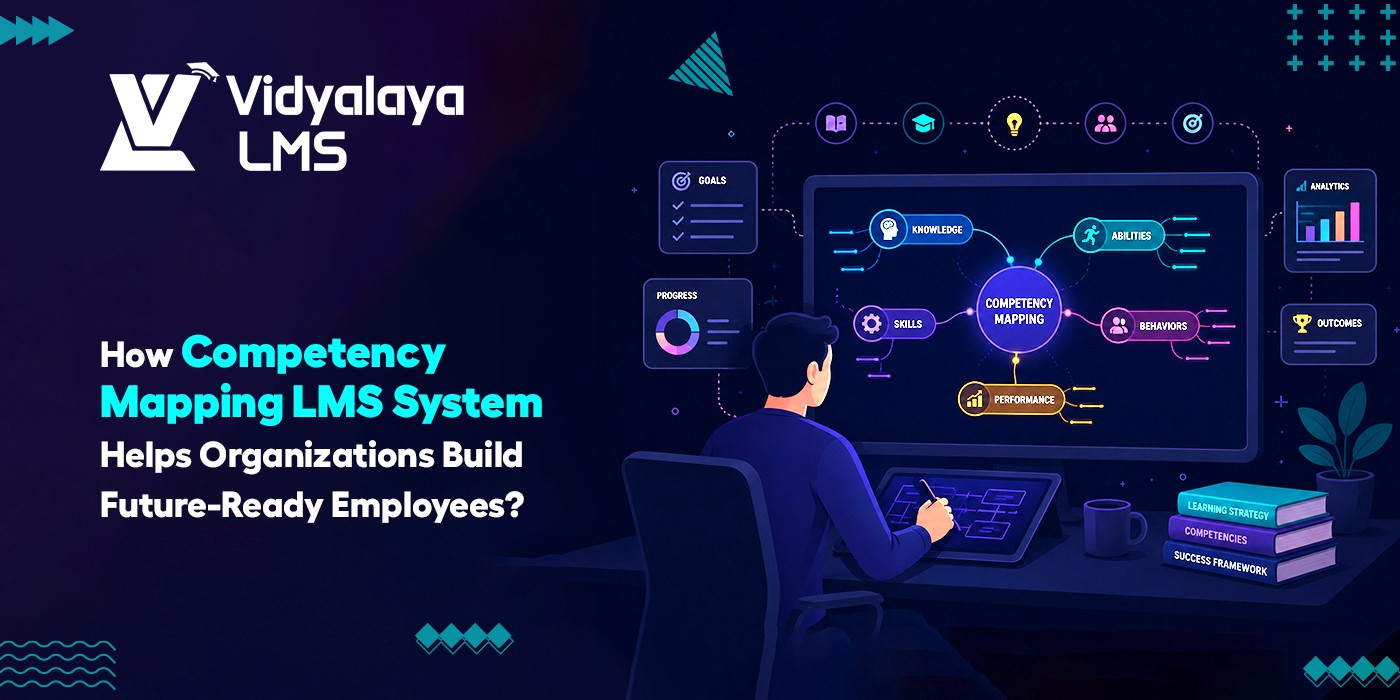
In many mid-sized organizations, workforce planning still relies heavily on fragmented data and manual skill assessments. HR teams often spend weeks compiling skills audits in spreadsheets that look organized but fail to provide real clarity on workforce readiness. When leadership asks critical questions—such as which employees are ready for senior roles or future leadership pipelines—the answers are often unclear or based on assumptions rather than actionable insights. Similarly, managers responsible for onboarding or developing talent frequently depend on personal judgment or experience due to the absence of a structured competency framework, leading to inconsistency in employee development across teams.
This gap between learning initiatives and actual business requirements creates long-term challenges such as skill shortages, misaligned hiring, and weak succession planning. A Competency Mapping LMS, like Vidyalaya LMS, bridges this gap by aligning employee skills with clearly defined role-based competencies. It enables organizations to move beyond simple training records and gain real-time visibility into skill gaps, employee readiness, and future talent needs. As a result, businesses can build a structured, data-driven approach to workforce development and create truly future-ready employees aligned with organizational goals.
What a Competency Mapping LMS Actually Handles Well?
Not every Learning Management System was built with skills architecture in mind. A lot of them are fundamentally content delivery platforms — good at tracking who completed what, less useful for understanding what that completion means for someone’s readiness to perform. The platforms that work well for competency management solve a different and more specific set of problems.
Role-specific competency frameworks that get used:
Generic competency models look thorough until someone tries to apply them to a real hiring or development decision. A Competency Mapping LMS that lets organizations define what each role requires — at each level of proficiency, across technical and behavioral dimensions — gives managers something they can work with. Not a library of competencies.
Skills gap identification without a manual audit:
The skills audit that takes a quarter to complete and is outdated before it’s finished is a familiar problem. Skills Management Software that continuously pulls from assessment results, completed learning, manager evaluations, and self-assessments gives organizations a live picture of where capability stands — by individual, by team, by department — without anyone having to compile it from scratch.
Succession planning with something solid underneath it.
A Competency Management System that maintains current, structured profiles of individual skills and readiness levels give succession planning an actual evidence base — which employees have the competencies the next-level role requires, who’s close, and what specific development would close the remaining gap.
What Smaller Organizations Often Get Wrong About This?
The assumption, often, is that competency mapping is an enterprise problem — something that makes sense for large organizations with dedicated talent analytics teams and the capacity to build and maintain complex frameworks. Smaller organizations typically assume they’re not the audience. That assumption tends to be costly.
A growing professional services firm that keeps hiring for roles without a clear definition of what competency at those roles looks like will keep making expensive hiring mistakes. Skills Management Software scaled for smaller teams doesn’t require a large implementation or a dedicated administrator — and the return arrives faster, because the gap it closes is often proportionally more significant.
Continuous Employee Development Through Real-Time Skill Tracking:
In traditional learning environments, employee development is often treated as a one-time activity tied to training completion rather than an ongoing, measurable process. However, in fast-changing business environments, skills can quickly become outdated, making periodic training insufficient for building a future-ready workforce.
A Competency Mapping LMS like Vidyalaya LMS enables continuous employee development by tracking skills in real time through assessments, learning activities, and performance feedback. This approach strengthens Competency Based Learning by ensuring that learning is directly aligned with role requirements and actual skill gaps. As a result, organizations can continuously monitor how employee capabilities evolve and ensure that every learning intervention supports both current performance and future business needs.
Conclusion:
When organizations operate in environments where job roles evolve faster than formal training cycles, workforce planning often becomes reactive rather than strategic. The real challenge is not just developing employees, but ensuring that development is mapped to clearly defined, measurable competencies that reflect actual business needs. This is where structured visibility into skills and readiness becomes essential for making confident decisions around promotions, internal mobility, and leadership pipelines.
By embedding competency-driven insights directly into the learning ecosystem, organizations can shift from assumption-based planning to evidence-based talent decisions. Vidyalaya LMS helps HR and L&D teams continuously align employee growth with organizational goals, ensuring that skill development is not isolated from business outcomes but directly connected to them. To explore how this can transform your workforce strategy and improve talent readiness, contact us for a free demo today.