






Managing employee training becomes increasingly complex as businesses grow, teams become distributed, and training requirements vary across roles and departments. Traditional classroom sessions, spreadsheets, and manual follow-ups can make it difficult to deliver consistent training and track employee progress. Online Employee Training Software gives businesses a centralized platform to manage onboarding, skill development, compliance training, assessments, and employee learning in one place.
With a digital training platform, employees can access courses and learning materials anytime, while HR teams and managers can assign training, monitor completion, and track results more efficiently. This helps organizations simplify training operations, reduce administrative work, and create a more structured approach to employee development.
In today’s guide, the reader will discover:
- What Online Training Solutions mean
- How an employee training system works
- Most significant features to look for
- Advantages of usage for Human Resources managers, leaders, and employees
- How it helps with onboarding and continuous education
What Is Online Employee Training Software?
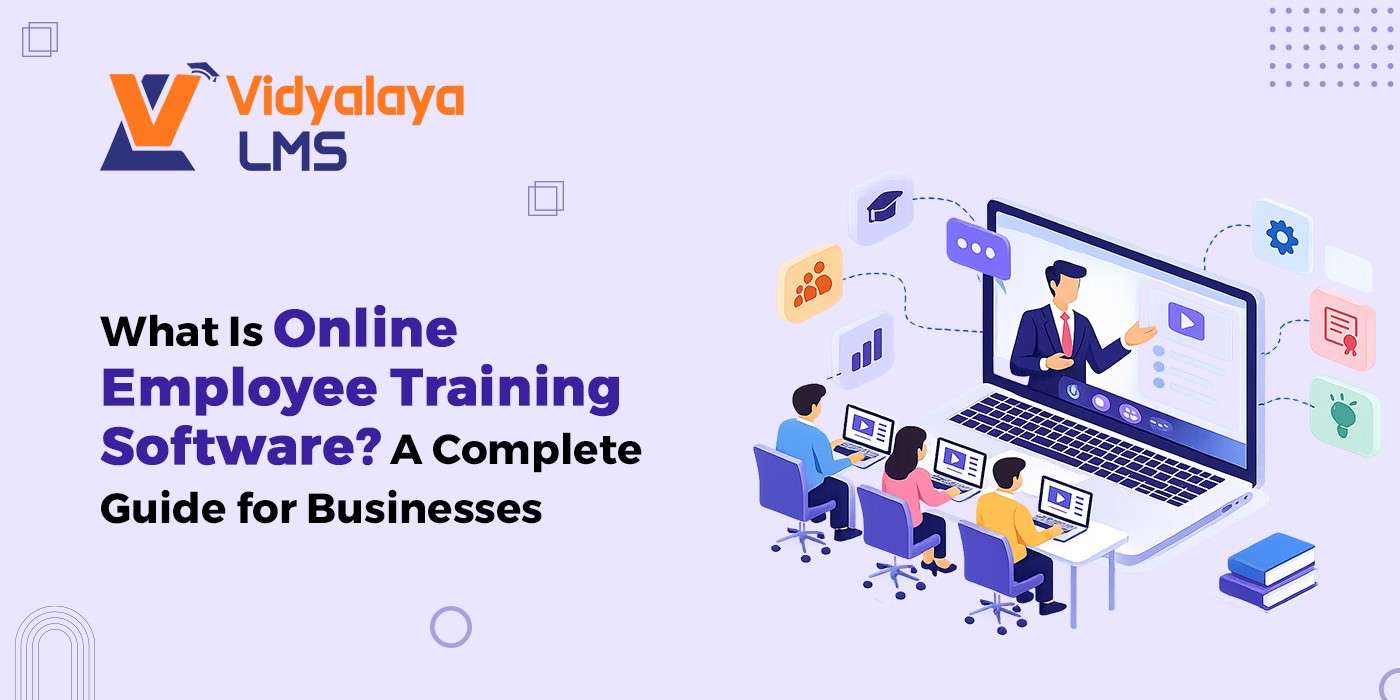
Online employee training software may be defined as any software that allows organizations to create, deliver, administrate and track training programs for their employees. Using such systems eliminates the need for keeping different training logs and files as they are maintained in one system that is easy to use. Employees can log in to the system, enjoy all training materials that were assigned to them, watch videos, take quizzes, carry out different educational activities and receive certificates if needed.
This also lets managers and HR departments track the progress of their employees’ training by understanding which of them have taken their course and what other training needs to be delivered. Thus, online training can be useful not only for small companies but also for larger firms having educational centres all over the world.
How Does an Employee Training LMS Work?
In practice, an employee training LMS integrates all stakeholders in this process: learners, instructors, training materials, evaluations, and reporting capabilities.
In this system, administrators upload or create training materials and assign the employees different training programs according to the particularities of their positions, tasks, experience, and internal regulations.
Key Features of Employee Training Software
The functions offered by an employee training management system can differ from one system to another. Nevertheless, certain features are desired by organizations, these include:
1. Course management
Organizations can create and handle courses from one centralized location. The courses can include documents, videos, presentations, live lectures and other materials.
2. Tests and assessments
Companies can assess whether employees have understood the content of the training by conducting different prejudices.
3. Monitoring of employee progress
HR personnel can track course completion ratio, assessment result, ongoing trainings.
4. Reports and analytics
By analysing training reports, organizations can get a better understanding of the participation and completion trends. With these insights, managers can detect people that need training or support.
5. Certificates
Certificates can be generated for selected training programs once an employee finishes all required learning activities or assessments successfully.
6. Role-specific training
Employees can be assigned training depending on their job roles, departments, teams, or needs. This ensures that right materials are provided to employees, instead of using a generic one-fit-for-all training program.
Benefits of Employee Training Software
The use of employee training and development software simplifies many aspects of learning processes in organizations.
The biggest advantage of such use is the possibility of easier access. Employees can utilize online materials for learning without the necessity of attending live classes. This is useful particularly for organizations with several units and distributed teams.
Another benefit is less administrative work. The HR team can assign learning and monitor progress as well as keep records about training in a single system.
Additional benefits include:
- Well-organized employee training.
- Simpler tracking of mandatory training.
- Less reliance on paper records.
- Flexible schedule of learning process.
- Centralized training information.
- Improved views of employees’ progress.
- Uniformity of the training process among various teams.
The actual outcome of implementation will depend on many factors, such as training strategy, features of the platform, employees’ level of engagement, and quality of training materials.
Online Training for Employee Onboarding
Employee onboarding is one domain where digital learning platforms can come in handy. New employees often require proper knowledge of company policies, business procedures, job requirements, tools, and culture within a very short time.
Employee onboarding and training software can be beneficial in this regard for the companies involved to create learning paths through providing required information for new employees.
For instance, the training given to new employees can comprise:
- Company policies and rules
- Information about the product or service
- Job-specific information
- Workplace compliance
- The tools that are used
- Departmental obligations
Rather than providing all the information at once, companies can devise a sequence of courses and tasks for the employees. After that manager will be able to monitor whether the necessary onboarding training has been finished.
Why Is Online Employee Training Becoming Important?
The work environment is progressing as businesses incorporate innovative technology and employees assume new responsibilities. The Future of Jobs Report 2025 by the World Economic Forum states companies believe that about 39% of workers’ current skills will not be relevant anymore from 2025 to 2030.
This fact shows the importance of the possibility for continuous learning for companies.
By using an employee learning management system, organizations can facilitate this process. Instead of carrying out the same training courses again in classrooms, organizations may create online courses.
Conclusion:
As employee training becomes more distributed and continuous, businesses need a reliable way to manage learning without adding unnecessary administrative complexity. Online employee training software helps organizations centralize training, simplify onboarding, track employee progress, and deliver role-specific learning at scale. The right platform can make employee development more structured while giving HR teams and managers better visibility into training activities and outcomes.
If your organization is looking for a simple and centralized solution to manage employee training, Vidyalaya LMS can help. From onboarding and compliance training to assessments, certifications, and progress tracking, Vidyalaya LMS brings essential training activities together in one platform. Contact us today for a free demo and explore how Vidyalaya LMS can support your organization’s employee training needs.