







The education landscape is rapidly evolving, and digital transformation has become a necessity rather than just a trend. As educational institutions expand, managing academic resources, student engagement, assessments, and learning outcomes becomes increasingly complex. A powerful Learning Management System (LMS) for educational institutions enables schools, colleges, universities, and training organizations to streamline academic operations, enhance collaboration, and deliver a seamless learning experience through an integrated LMS portal. With the right educational LMS software, institutions can simplify course management, improve teaching efficiency, and create a more engaging environment for both educators and learners.
Over the past decade, digital classrooms, online learning, and hybrid education models have reshaped the way institutions deliver knowledge. A modern LMS solution provides a centralized platform where educators can create and manage courses, share learning materials, conduct assessments, track student performance, and analyze learning progress effectively. By replacing multiple disconnected tools with a single integrated system, LMS software for schools helps institutions improve productivity, optimize the learning process, and build a scalable digital education ecosystem that supports long-term growth.
Get to know the reasons for adopting LMS systems by many educational institutions! These systems are designed to:
- Support both online and hybrid learning
- Improve the access to educational resources
- Facilitate the educational management process
- Improve communication between teachers and learners
What is an LMS Solution for Educational Institutions?
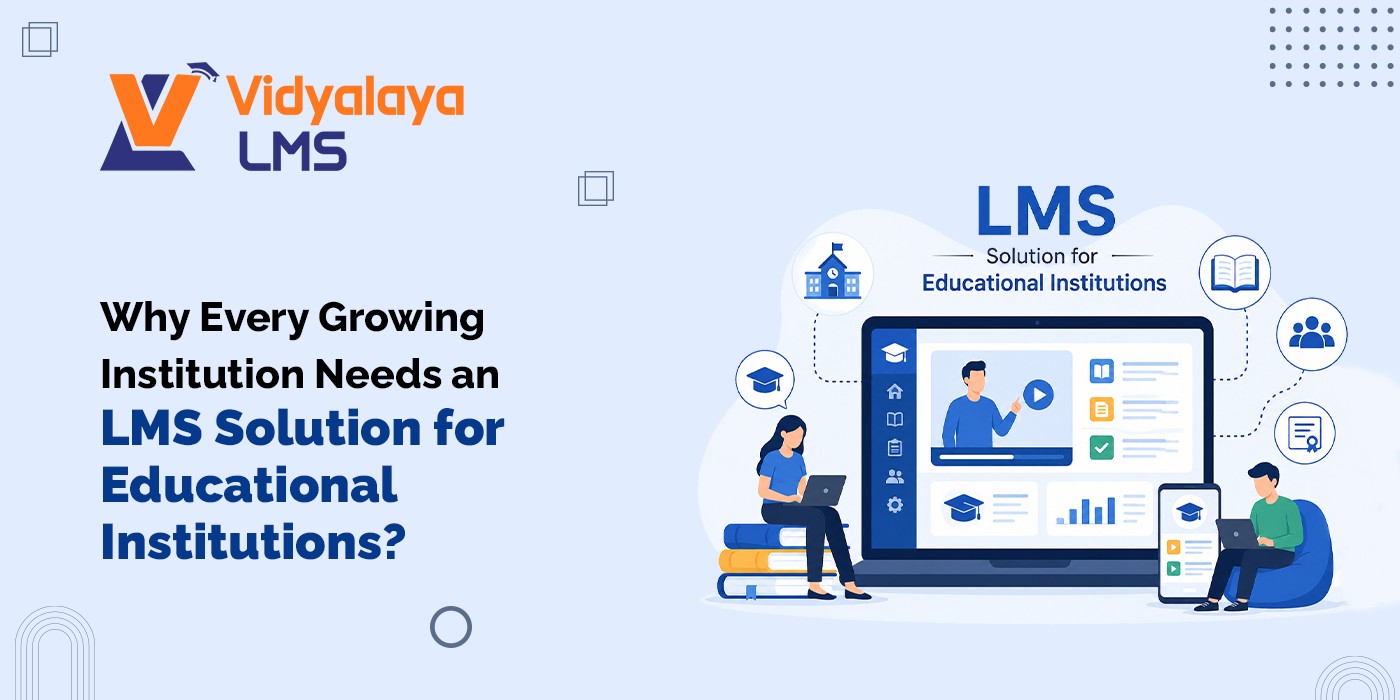
An LMS for Educational Institutions is a software program that helps schools, colleges, universities, and other training establishments to carry out their educational process from a digital standpoint. Therefore, such systems allow professors to create courses, upload materials, conduct online lectures, complete assignments, and monitor learners’ progress through one centralized platform, supporting LMS assessment tracking in higher education institutions.
As more educational institutions emerge, the complexity of managing academic processes increases. The Learning Management Program simplifies many petty tasks and allows educators to concentrate on quality of education.
LMS tool usually has the following characteristics:
- Course and content management
- Assignment and assessment tools
- Performance tracking
- Communication and collaboration features
Why Institutions Need an LMS?
Managing an institution in a state of growth often requires combining the teachers, students, classrooms, and academic resources. Computer-based systems reduce the need for paperwork and eliminate communication barriers.
Students today demand the flexibility to learn at their own convenience. With the help of an LMS, students can access and process educational content.
Benefits of LMS for educational institutions include:
- Minimization of manual admin work
- Enhanced teacher-student communication
- Flexibility in learning
- Uniformity of the educational process
Key Benefits of a Learning Management System:
A Learning Management Software does not only provide online courses or classes. It helps improve the teaching process and learning by bringing all educational materials together in one secure place. Students can access the lectures, notes, tasks, and quizzes conveniently without any need to install different applications.
Teachers benefit from automated assessment, getting the data that shows students’ progress.
The main advantages are:
- Centralized materials
- Reports on students’ progress
- The possibility to use interactive quizzes and tests
- M-learning and online availability
At the same time, the educational institutions can engage their students using various discussion forums, multimedia materials, webinars, and tailor-made learning pathways.
LMS for Schools & Colleges:
Universities and colleges utilize LMS System to teach their courses, but the specifics of LMS for schools are different from those of LMS for college.
Schools use the capabilities of Learning Management Systems to facilitate the process of learning in the classroom, manage homework and attendance, communicate with parents, and create opportunities for engaging learning for younger students.
LMS for colleges includes advanced capabilities to organize academic processes such as semester courses, project management, tests, department management, and research interactions.
Among the general features of LMS that are used by both kinds of educational institutions are:
- Virtual class
- Managing the assignments
- Examinations
- Performance evaluation
Choosing the Best LMS Software:
In choosing suitable LMS Software, institutions must undertake a systematic assessment of their present and future requirements. An appropriate LMS solution for educational institutions must be simple to use, flexible and expandable, secure, and able to establish integration with ERP systems and other education-based applications.
Institutions must now make sure that the platform has the capability of handling expanded user volumes in the future.
Features to look for include:
- Cloud-based feature
- Well-designed mobile application
- Smart features based on AI
- Adequate safety and privacy measures
- Seamless integration with currently worked systems
Conclusion:
As educational institutions continue to embrace digital transformation, having the right technology partner has become essential for improving academic efficiency and delivering impactful learning experiences. A powerful Learning Management System enables institutions to move beyond traditional processes by automating daily operations, simplifying content management, improving communication, and providing valuable insights into student performance. With the right LMS solution, institutions can build a flexible, scalable, and technology-driven learning environment that supports the needs of educators and learners.
Vidyalaya LMS helps schools, colleges, and universities streamline their entire learning ecosystem through an intuitive and feature-rich LMS platform. From managing courses and assessments to tracking learner progress and enabling seamless collaboration, our solution is designed to help institutions achieve better academic outcomes. Connect with Vidyalaya LMS today for a free demo and explore how our Learning Management System can support your institution’s journey toward smarter and more efficient digital education.