







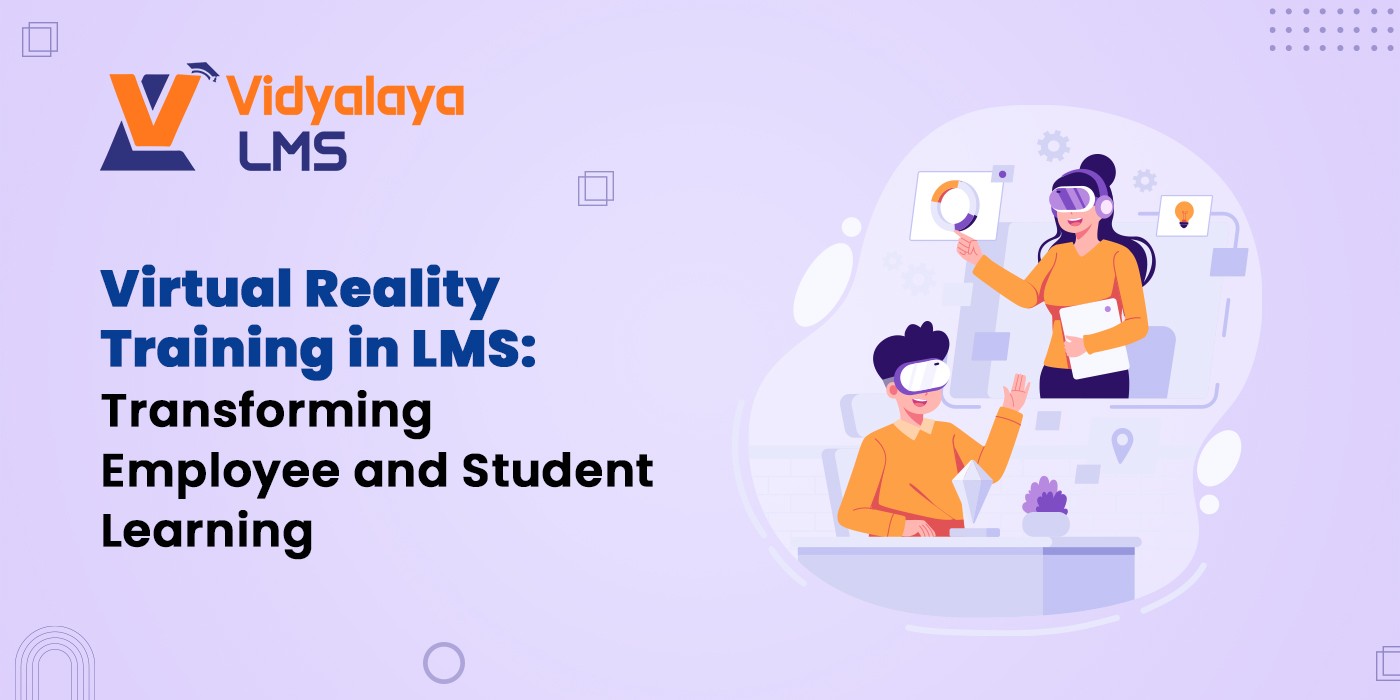
Traditional learning methods, such as presentations, manuals, and videos, often struggle to keep learners engaged or ensure long-term knowledge retention. Virtual Reality (VR) training transforms learning by delivering immersive, hands-on experiences where employees and students actively participate in realistic scenarios. By simulating real-world environments, VR enables learners to practice skills, make decisions, and learn from mistakes in a safe and controlled setting—significantly improving engagement, understanding, and retention.
When Virtual Reality training is integrated with Vidyalaya LMS, organizations and educational institutions gain a powerful, data-driven learning solution. The LMS enables seamless delivery of VR content while tracking learner progress, performance, and assessments in real time. This integration ensures scalable, measurable, and outcome-focused training programs, helping businesses build skilled workforces and institutions deliver impactful, future-ready education.
How Virtual Reality Actually Works?
Here’s the thing about VR—it feels real. You put on a headset and boom—you’re in the action. Machines, experiments, historical events—you can see it, touch it, even mess things up. Mistakes? Totally fine. That’s kind of the point, isn’t it? An LMS for Virtual Reality Training ensures those mistakes actually teach you something. Without it, VR is just a cool demo, you know? But with it? It’s real learning. The LMS keeps track of your progress, shows you where you went wrong, and helps guide the experience. Imagine learning to operate machinery, or practicing surgery, or even running a complicated chemistry experiment, all without risk. That’s the beauty of combining VR with a learning management system—it makes the experience measurable and meaningful instead of just…fun tech.
Why Virtual Reality Training Is Growing?
VR training is growing everywhere, and for good reasons. Companies love it—especially jobs that are risky, complicated, or just expensive to train for. Cheaper, safer, and employees get to practice without fear of messing up. Schools and universities are doing it, too. Students can run experiments, explore complicated equipment, even “walk through” history (like literally stepping into ancient Rome or something) without anything breaking. LMS Software makes it all manageable. Teachers and managers can see who’s struggling, adjust lessons, track progress, and basically make sure everyone is learning something instead of just…pretending to. Traditional learning? Pretty passive. You watch, you read, and hope it sticks. VR flips that. You’re doing it. You’re interacting. And with LMS for VR Training, every mistake, every action, counts. Every interaction is tracked, which is kind of amazing if you think about it.
Building Confidence Through VR:
Confidence is huge here. Employees trained in VR feel ready for real situations—they have “been there” safely, which matters a lot. Students remember more because they experience it directly instead of just reading about it in a textbook. LMS for VR Training ensures that the whole thing is structured, personalized, and measurable. Everyone benefits—learners gain skills, teachers/managers gain insight. Safety is another big plus. Aviation, healthcare, and manufacturing—real-life training can be dangerous, expensive, or both. VR fixes that. LMS lets you scale it, too. The same program can run across multiple locations, multiple classrooms, without losing quality. Students or employees can experiment, fail, try again—all safe. And customization? Huge. Trainers can design lessons for beginners or advanced learners. LMS tracks engagement, adjusts lessons, and learners can focus on what they need, skip what they know. Textbooks? They don’t do that.
Why VR + LMS Matters?
Honestly, VR + LMS isn’t just a trend. It’s immersive, practical, and measurable. Employees gain confidence. Students gain understanding. Organizations see results. LMS Software keeps even complex VR experiences organized. Bridges theory and practice in ways traditional training can’t. And the best part? Learning actually becomes…fun. Mistakes aren’t scary. Challenges are engaging. You’re not memorizing—you’re experiencing it. LMS for VR Training scales across teams, classrooms, companies, big or small. Everyone benefits.
Conclusion:
The combination of Virtual Reality training and modern LMS Software is no longer an innovation experiment—it is a competitive advantage. Organizations and educational institutions that adopt VR-enabled learning gain higher engagement, faster skill acquisition, improved retention, and reduced training risks. With Vidyalaya LMS, immersive VR experiences are supported by structured learning paths, real-time tracking, and actionable insights, ensuring every training initiative delivers measurable business and learning outcomes.
Take the next step toward future-ready training with Vidyalaya LMS. Schedule a call with our team or contact us today to discover how our LMS Software can help you implement scalable, immersive, and performance-driven VR training programs tailored to your organization’s goals.