







The concept of AI Assessment is revolutionizing how assessments are being carried out by educationalists through the merging of traditional assessment techniques and intelligent digital systems. The traditional method of manually assessing students’ work is being enhanced by AI-based solutions that help prepare questions, analyze answers, recognize patterns of performance, and give instant feedback.
With the rapid advancement of digital education, institutions are now considering how these systems may be helpful for evaluation purposes. The purpose of this blog is to illustrate how AI is revolutionizing the process of evaluation, advantages and drawbacks of intelligent evaluations, and how Vidyalaya LMS can help facilitate digital education and assessment.
What are the AI assessment tools for teachers?
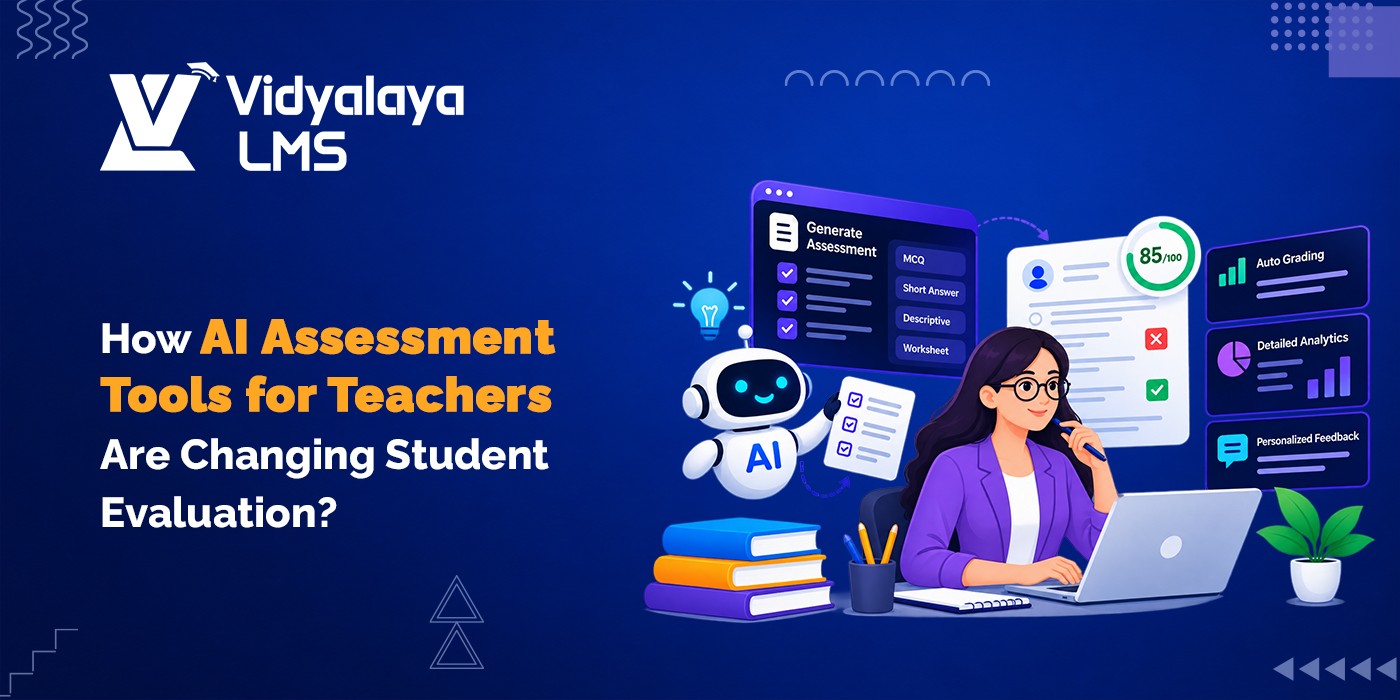
AI assessment tools for teachers are technological means that employ artificial intelligence technology to facilitate various aspects of the process of evaluating students. Based on their functionality, these tools allow teachers to build questions, evaluate types of answers, analyze the results, and find out topics that require further learning from students.
Thus, while preparing a science test, a teacher can use AI assessment tool to formulate questions at various difficulty levels. Once students have completed the assessment, the available analytics will allow the teacher to spot the concepts that are difficult for the learners.
Common capabilities include:
- Generating quizzes and question sets based on learning objectives.
- Supporting automated evaluation of suitable question types.
- Providing feedback on selected responses.
- Summarizing assessment results and performance patterns.
- Identifying potential learning gaps.
- Helping teachers prepare additional practice activities.
These capabilities vary between platforms. AI-generated questions and feedback should always be reviewed by educators to ensure accuracy, relevance, and alignment with the curriculum.
How AI Is Altering Traditional Approaches to Evaluating Students?
Traditional assessments remain important, although the manual process can consume much of a teacher’s time. AI can help perform repetitive functions and offer more insight into the process provided appropriate use is made.
1. Fast Assessment Development
The preparation of an assessment involves choosing the right questions of different levels of complexity and ensuring their correlation with the objectives of the study
2. Automated Assessment and Feedback
There are some types of assessments that can be automatically assessed by teachers. This allows teachers to look at the results faster and provide feedback without looking through every response one by one.
3. Identifying Learning Gaps
Assessment results provide useful information about students’ understanding. AI-supported analytics can help organize these results and highlight patterns, such as repeated mistakes in a particular topic
Key Benefits of AI Tools for Educational Assessment
It can be useful for teachers because they can streamline the process of assessment, making the data analysis process easier.
Reduction in Administrative Work
Formulating questions, checking structured answers, and then compiling the results require a lot of teachers’ time. Certain administrative procedures can be optimized with AI-assisted workflow.
Prompt Feedback
It is essential that students receive an explanation about mistakes they made soon after the assessment process.
Personalized Learning Experience
Sometimes students need more time to grasp certain material than other students do. With the help of information provided by assessments, a teacher will be able to give his/her students some extra tasks and explanations.
Improvement of Information
A compilation of the results of the assessment will allow teachers to understand what problems all the students have. This information will be helpful while planning lessons.
Assessment Flexibility
With the help of AI, teachers can prepare a variety of question formats and practice materials of different levels of complexity.
Challenges and Correct Use of AI in Assessment
Although AI gives certain benefits, educational institutions must consider its drawbacks when introducing such solutions.
- Accuracy:
The questions, answers, and feedback generated by the AI system could be incorrect and thus should be double-checked by a person. - Objectivity:
The computerized assessment system may fail to notice the diversity of ways in which the students convey their knowledge. - Confidentiality:
The information obtained through assessment must be protected, with appropriate access management measures taken. - Academic integrity:
There must be guidelines about correct usage of AI in assignments and examinations. - Teacher’s responsibility:
Teachers should remain responsible for interpretation of the results and major decision-making processes concerning the students. - Digital divide:
Assessment has to involve those students who have different technological requirements.
Conclusion
AI assessment tools are transforming the way educational institutions evaluate student performance by simplifying assessment creation, speeding up feedback, and helping teachers identify learning gaps more effectively. By leveraging AI-assisted assessment tools, institutions can enhance teaching efficiency, improve student engagement, and make data-driven decisions that support better learning outcomes. Combining AI-powered capabilities with a reliable Learning Management System (LMS) is essential for effective assessment management, data security, and meaningful teacher oversight.
Vidyalaya LMS helps educational institutions streamline digital learning and assessment management through a centralized platform designed to support teachers, students, and administrators. By adopting the right AI assessment software, institutions can monitor student progress, optimize assessment workflows, and create more effective digital learning experiences. Contact us today for a free demo and discover how our LMS solutions can support your institution’s digital learning and assessment goals.