





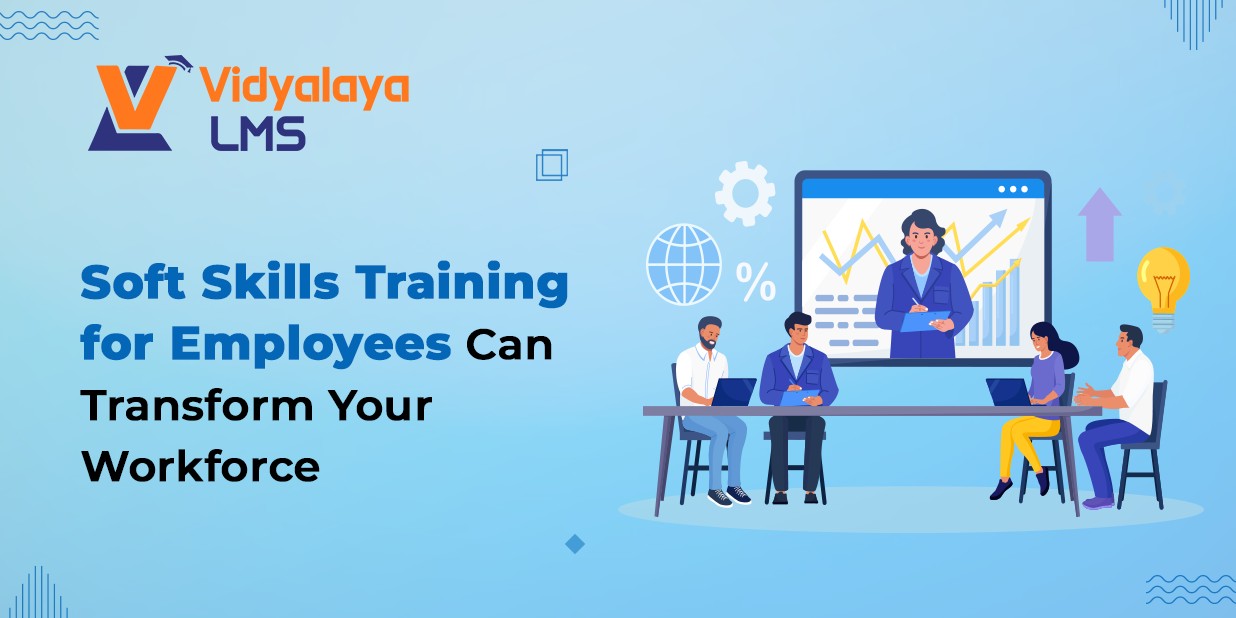
Soft Skills Training for Employees Can Transform Your Workforce

Vidyalya LMS

Why do highly skilled teams sometimes fail to deliver results? The challenge often isn’t technical knowledge, but how employees communicate, collaborate, and lead. Gaps in soft skills can hinder productivity, reduce engagement, and limit overall organizational performance.

Forward-thinking organizations now view soft skills training as a critical business strategy. Investing in employee development enhances teamwork, fosters confident decision-making, and prepares individuals to take on leadership roles—ultimately driving measurable improvements in workplace efficiency and culture.

With advanced remote training software and platforms like Vidyalaya LMS, businesses can deliver consistent, scalable, and engaging soft skills training across their workforce. By equipping employees with essential interpersonal skills, companies can strengthen collaboration, boost performance, and gain a competitive edge in today’s fast-evolving market.

Why Soft Skills Matter More Than Ever?

Companies tend to devote huge amounts of resources to technical or job-related learning while neglecting non-job-related skills training, such as communication, emotional intelligence, and leadership.

Here’s the reality:

  • A technically skilled employee who cannot communicate clearly can slow down projects.
  • A manager without leadership skills can demotivate an entire team.
  • Poor collaboration leads to missed opportunities and conflicts.

What is Soft Skills Training for Employees?

Soft skills training for employees focuses on developing interpersonal and behavioural skills that enhance workplace effectiveness.

These include:

  • Communication skills
  • Teamwork and collaboration
  • Problem-solving
  • Adaptability
  • Leadership and decision-making
  • Time management

When delivered effectively through the Remote Training System, organizations can train employees anytime, anywhere—especially in hybrid and remote work environments.

Key Benefits of Soft Skills Training:

  1. Improved Communication: Clear communication reduces misunderstandings and increases productivity across teams.
  2. Stronger Team Collaboration: Employees learn how to work better together, leading to smoother workflows.
  3. Better Leadership Development: Future leaders are shaped through consistent employee development training.
  4. Higher Employee Engagement: Employees feel more confident and valued when their skills improve.
  5. Increased Productivity: Efficient communication and collaboration directly impact output.

How Soft Skills Training Transforms Your Workforce?

Let’s break it down with a simple comparison:

Before Soft Skills Training

After Soft Skills Training

  • Miscommunication in teams
  • Clear and effective communication
  • Low employee morale
  • High engagement and motivation
  • Poor conflict handling
  • Constructive problem-solving
  • Weak leadership pipeline
  • Strong, confident leaders
  • Resistance to change
  • Adaptable and flexible workforce

This transformation highlights how workplace skills training creates a more resilient and future-ready organization.

Role of Remote Training Software:

With remote and hybrid work becoming the norm, LMS Software has become a game-changer.

Why it works:

  • Accessible from anywhere
  • Cost-effective compared to in-person training
  • Scalable across teams and locations
  • Enables continuous learning

Best Practices for Implementing Soft Skills Training:

To make your employee development training effective, follow these strategies:

  1. Identify Skill Gaps: Understand what skills your workforce lacks before designing training.
  2. Customize Training Programs: Different roles require different soft skills—avoid one-size-fits-all.
  3. Use Interactive Learning: Workshops, role-playing, and real-life scenarios work better than lectures.
  4. Leverage Remote Training Software: Ensure flexible and continuous access to soft skills training.
  5. Measure Outcomes: Track improvements in performance, engagement, and communication.

Challenges Companies Face (and How to Overcome Them):

Challenge

Solution

  • Employees don’t take training seriously
  • Make training engaging and relevant
  • Lack of time
  • Use microlearning via Remote Training Software
  • Difficulty measuring ROI
  • Track KPIs like productivity and engagement
  • Resistance to change
  • Communicate benefits clearly

 The Long-Term Impact:

Organizations that invest in soft skills training for employees see long-term benefits such as:

  • Strong organizational culture
  • Better client relationships
  • Improved retention rates
  • Enhanced innovation and creativity

Conclusion:

Investing in soft skills training is no longer optional—it is a strategic move that directly impacts organizational performance, employee engagement, and leadership development. By equipping your workforce with strong communication, collaboration, adaptability, and leadership skills, your organization can foster a culture of productivity, innovation, and resilience.

With modern remote training platforms like Vidyalaya LMS, delivering scalable, interactive, and consistent soft skills training has never been easier. Organizations can ensure employees across all teams and locations develop the interpersonal skills needed to thrive in today’s fast-paced business environment.

Transform your workforce, strengthen your leadership pipeline, and drive measurable business results. Contact us for a free demo to see how Vidyalaya LMS can help your employees unlock their full potential and take your organization to the next level.

Frequently Asked Questions

1. Why should my organization invest in soft skills training for employees?

Investing in soft skills training helps employees communicate effectively, collaborate seamlessly, and lead confidently. This leads to higher productivity, stronger engagement, and a resilient workforce capable of driving business growth. Contact us for a free demo to see how Vidyalaya LMS can help your team.

2. What are the key soft skills employees need today?

Essential skills include communication, teamwork, problem-solving, adaptability, leadership, decision-making, and time management. These skills improve workplace effectiveness and prepare employees for evolving business challenges.

3. How can soft skills training impact business performance?

Employees with strong soft skills make fewer errors, handle conflicts constructively, and collaborate more effectively. Organizations benefit from higher productivity, improved client relationships, and a stronger leadership pipeline.

4. Can soft skills training be delivered remotely?

Yes. Platforms like Vidyalaya LMS allow employees to access training anytime, anywhere, making it ideal for remote and hybrid work environments. This ensures consistent and scalable learning across all teams.

5. How do I measure the effectiveness of soft skills training?

Effectiveness can be tracked through KPIs such as improved communication, team collaboration, leadership growth, employee engagement, and overall productivity. Vidyalaya LMS provides analytics to measure outcomes accurately.

6. What challenges do companies face in implementing soft skills training?

Common challenges include low employee engagement, time constraints, resistance to change, and difficulty measuring ROI. Solutions include interactive learning, microlearning modules, clear communication of benefits, and leveraging remote training software.

7. How quickly can my organization see results from soft skills training?

While some improvements, like communication and collaboration, can be noticed immediately, long-term benefits—such as leadership development and cultural transformation—become evident over months of consistent training.

8. How do I get started with soft skills training for my employees?

Start by identifying skill gaps, customizing training programs for different roles, and leveraging interactive, remote-enabled learning platforms like Vidyalaya LMS. Contact us for a free demo to explore how our solution can transform your workforce.

author

The Author

Kumaril Patel

CEO & Co-Founder

LinkedIn Icon

Kumaril Patel is the CEO & Co-Founder of Sapphire Software Solutions, a global technology company specializing in software, mobile app, and web development. With over 20 years of diverse IT leadership, he has built international business operations from the ground up and led the leading flagship digital platforms such as Vidyalaya School Management System and OccuCare Occupational Health Management System.

Kumaril is known for transforming ideas into high-impact technology solutions—leading cross-functional global teams and building innovation-driven ecosystems. His strategic vision has enabled long-standing collaborations with global enterprises including American Express, Bayer, TATA Group, Adani Group, Larsen & Toubro, Honda, Toyota and Vedanta Limited.

Passionate about innovation, AI, and cloud technologies, Kumaril focuses on empowering organizations to scale globally while solving real-world challenges through transformative digital solutions.

Related Blog

sapphire
March 23, 2026 5 min read
An administrator of a learning management system is vital for the management, support, and optimization of the organisation’s digital learning environment. With corporate training software becoming so important for companies to train their employees, the administrator must keep the system running smoothly to ensure that the employee has the correct learning experience. The LMS administrator serves as the operational backbone of the modern workplace learning by creating online courses, tracking learner progress, etc… Because of the digital world we now live in, businesses are heavily investing in different platforms to improve employee productivity and performance (such as sales training software, […]
Read More Vidyalaya LMS
sapphire
February 7, 2025 4 min read
Job training empowers people to realize their dreams and improve their lives.- Sylvia Burwell. In every professional career, training regarding the relevant job profile is one of the primary phases. It helps people develop new skills and improve existing ones, which can impact performance and result in success in their careers afterwards. Training increases the knowledge and skills of an employee for accomplishing a particular task. Understanding the significance of every organization implementing a standard training process. With the advancement of time, organizations have moved to automated options with the help of tailor-made learning management software. Let’s learn why and […]
Read More Vidyalaya LMS